





























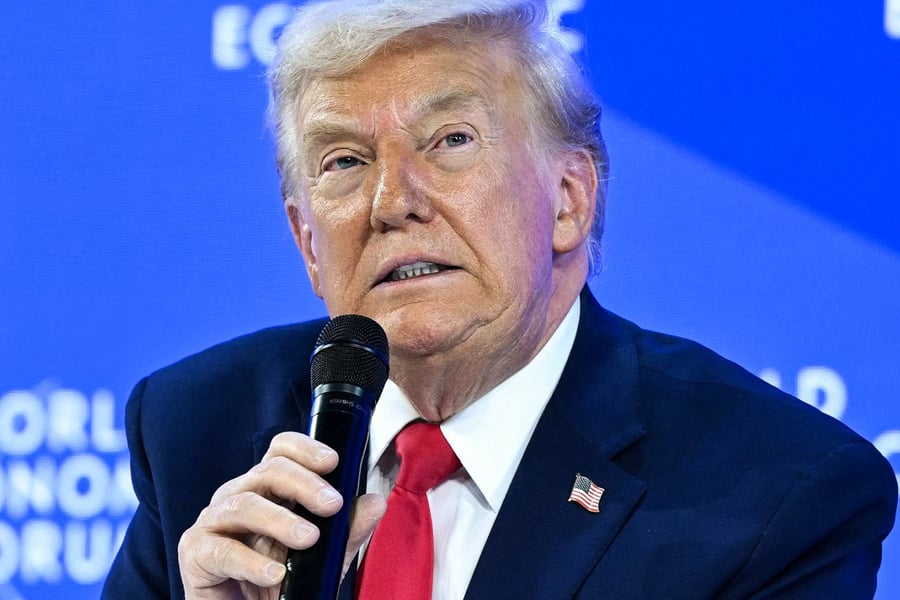
“People thought I would use force. I don’t have to use force. I don’t want to use force. I won’t use force.”
This statement, made by President Donald Trump at the World Economic Forum in Davos, Switzerland, generated a collective sigh of relief in Europe and America. The worst-case scenario — the United States attacking one of its NATO allies to seize territory — seems to be off the table.
For now.
“All the United States is asking for is a place called Greenland,” Trump added.
Despite signs of a burgeoning deal with Denmark to placate him, there will be a long reckoning for the unnecessary crisis manufactured by the American president. The damage is already done. Many American allies look at the U.S. with increasing dismay and wariness.
“The problem isn’t Trump. The problem is the U.S.,” writes Lars Christensen, a Danish economist who runs the financial advisory firm Paice. “When the outside world observes Trump’s insane behavior and his threats against allies, and we at the same time observe that there is no real action from the U.S. public, Congress, the U.S. Supreme Court, or the U.S. media about this insanity, we will all have to conclude that the U.S. accepts this behavior.”
This sentiment has been echoed to Rolling Stone in several candid conversations with European officials and analysts.
Love Music?
Get your daily dose of everything happening in Australian/New Zealand music and globally.

“There is a much bigger problem than anyone wants to admit,” says one Swedish security official with experience working with the Trump administration. “Even aside from Greenland, it is clear to us that Washington is not on the same page as the rest of NATO, no matter what the president says. We fear this will be an issue for years to come.”
The Greenland crisis entered its apogee on Sunday, when Trump sent a now-infamous letter addressed to Norwegian Prime Minister Jonas Gahr Støre, and distributed widely to European diplomats by the U.S. State Department. It demanded Greenland as compensation for Trump’s lack of a Nobel Peace Prize, written in Trump’s preferred informal style, random noun-capitalization and all.
“Considering your Country decided not to give me the Nobel Peace Prize for having stopped 8 Wars PLUS, I no longer feel an obligation to think purely of Peace, although it will always be predominant, but can now think about what is good and proper for the United States of America,” Trump wrote.
“I have done more for NATO than any person since its founding, and now, NATO should do something for the United States,” he continued. “The World is not secure unless we have Complete and Total Control of Greenland.”
That the president decided to bring Norway into the picture — as Greenland is a semi-autonomous part of Denmark, a completely different country – is a sign of either the president’s ignorance or obsession with the Peace Prize — or both.
The self-absorbed derangement on display in this missive caught even stalwart Trump supporters off guard, with some initially decrying its message and asserting the letter must surely be a hoax. Upon learning it most assuredly was not, they promptly flip-flopped to defend the “genius move.” Such is the high-wire balancing act required of one who supports a president who — politics aside — has a mind that has passed its recommended “Use By” date.
Trump’s veiled threat to abandon peace was reinforced by his subsequent refusal to rule out a military option. When NBC News asked him on Tuesday if he would use force to seize Greenland, Trump replied simply: “No comment.”
To add insult to injury, Trump further insisted that the U.S. has gotten “nothing” out of NATO. This is a slap in the face to America’s NATO allies, who sacrificed more than 1,000 soldiers in the U.S. war in Afghanistan, and especially to Denmark, which sent 18,000 soldiers there — with 43 never coming home.
“Every day Trump remains in office, distrust of the U.S. increases, and the cost for the U.S. will go up day by day. And this is irreversible. It takes years to build trust, but you can destroy it by your actions in minutes,” the economist Christensen observes.
Military action against Greenland would almost certainly spell NATO’s doom, which is unlikely to have bothered the U.S. president, who has never been a fan of the alliance — judged by most historians to be the most successful pact in history.
As far back as 1987, after a visit to Moscow to pursue investment opportunities, Trump spent nearly $100,000 (about $285,000 in today’s dollars) on full-page ads inveighing against the alliance. He has now surrounded himself with vocal critics of both the European Union and of NATO.
Trump’s bull-in-the-china-shop efforts to pull out of NATO unless member states picked up more of the tab for their defense — a refrain since his first term in office began nearly 10 years ago — have yielded results. Overall, defense spending by NATO members has increased markedly, but much of that is driven less by American prodding, and more by concern over Russia’s invasion of Ukraine starting in 2022.
But Trump was never really interested in other countries’ military spending. That is something tacked on to his anti-alliance antics by more responsible policymakers within the White House. In any case, destroying NATO would be a strange way to reform it — although not out of character for an administration that has methodically dismantled sources of American global influence and soft power.
Hard power, Trump and his cohorts believe, is the only currency that matters. Riding high on the martial prowess displayed by Special Operations Command in kidnapping the Venezuelan president a mere two weeks ago, it shouldn’t then be surprising that Trump is now emboldened to throw his weight around and bully whomever he wishes.
That obviously does not include Russian President Vladimir Putin. After a year of failed diplomacy, Trump appears to have finally accepted that his sycophantic goodwill to the Kremlin’s dictator will not be reciprocated with a peace deal in Ukraine. He still has yet to enact secondary sanctions on Russia. Despite supposedly giving a greenlight to a sanctions bill intended to squeeze Russian energy revenues, it continues to languish in congressional limbo.
In fact, Trump is far more focused on getting Putin to join his “Board of Peace.” This organization — ostensibly proposed to work for a permanent solution to the crisis in Gaza — has been revealed as little more than an grift. The board’s charter and invitation letters made public by various world leaders outline what sounds like a pay-for-play exclusive networking club — with membership to the tune of $1 billion a pop and Trump as chairman for life.
Many prominent leaders, such as French President Emmanuel Macron and British Prime Minister Keir Starmer, have already turned it down. But if Putin does decide to accede, he will join the leader of the free world at the table with such champions of liberty as Turkish President Recep Tayyip Erdoğan, Belarusian President Aleksandr Lukashenko, and Hungarian Prime Minister Viktor Orbán.
“We knew the story of the international rules-based order was partially false, that the strongest would exempt themselves when convenient, that trade rules were enforced asymmetrically,” Canadian Prime Minister Mark Carney said in a speech at Davos on Tuesday. “And we knew that international law applied with varying rigour depending on the identity of the accused or the victim.
“This fiction was useful, and American hegemony, in particular, helped provide public goods, open sea lanes, a stable financial system, collective security and support for frameworks for resolving disputes,” Carney said. “This bargain no longer works. Let me be direct. We are in the midst of a rupture, not a transition.”
However one feels about the neo-liberal world order that America has dominated for decades, you needn’t look too deeply into the historical record to understand that when established orders collapse, it means more war, greater economic hardship and scarcity, and less freedom.
It will also mean more nukes, as an array of nations previously protected by America’s nuclear umbrella seek the ultimate security guarantee — something already being contemplated, from Seoul to Stockholm.
Trump’s push for Greenland is against a backdrop in which authoritarian states are attempting a revolutionary reordering of the global system, returning humanity to a world of armed imperialism in which the strong consume the weak. Whether this can correctly be called Realism on the part of the U.S. is debatable; a key aspect of such a philosophy is the pursuit of self-interest, not self-sabotage.
In an upside-down world, madness is painted as strategy, while provincialism and ignorance are touted as sophistication and wisdom. Hubris is paraded as strength. But hubris is ever the precursor to downfall.
For now, despite these seismic shocks permanently altering America’s trajectory with its allies, Trump’s speech in Davos contained the magic formula to generate relief on both sides of the Atlantic: “I will not use force.”
Which is good, because if the president were to dispatch the U.S. Army’s 11th Airborne Division, the “Arctic Angels,” to seize Greenland’s largest airbase, the soldiers might be in for a surprise.
Under an existing agreement with Denmark, it’s already defended by the U.S. Space Force.
From Rolling Stone US

