





























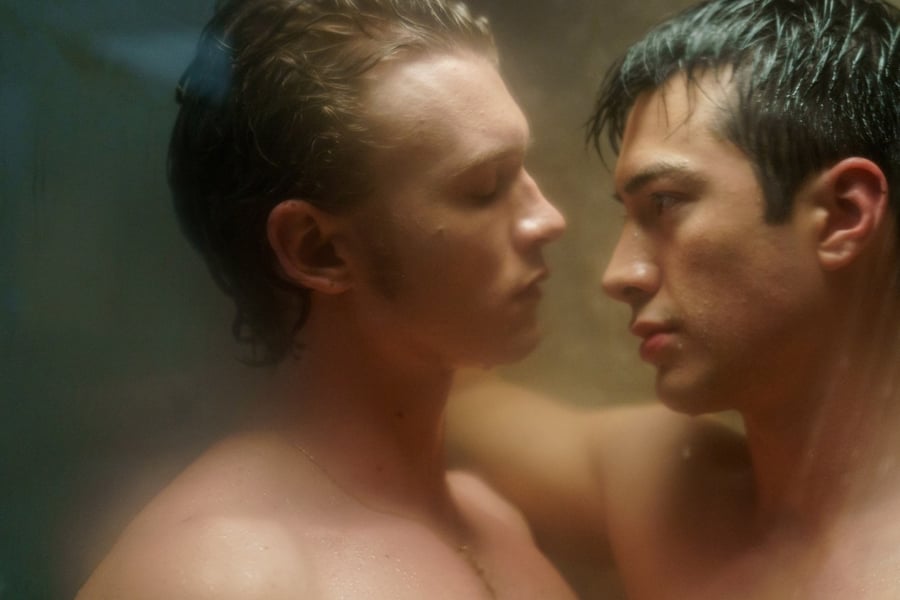
No one — not creator Jacob Tierney, or author Rachel Reid, or stars Connor Storrie and Hudson Williams — knew that the steamy hockey series Heated Rivalry would be a runaway hit.
It’s only been less than two months since the Crave Original’s Nov. 28 premiere, but the series has blown up in a way even the show’s most involved collaborators could never have imagined. Heated Rivalry charts the secret love story of rival hockey players Shane Hollander (Williams) and Ilya Rozanov (Storrie) as they go from rookies to famed NHL stars. Support for the show has grown exponentially, turning Williams and Storrie from virtual unknowns to highly anticipated late-night guests and presenters at the Golden Globes. (“Everyone wants to meet you,” Tessa Thompson cooed to Williams at a recent Chanel party at the Chateau Marmont, as cameras captured his blush.) It’s an unexpected moment for a series that was produced by a Canadian streaming service best known for making beloved cult hits like Tierney’s Letterkenny. But while fans are focused on the show’s steamy scenes, there’s another group that could benefit from the attention: real life hockey teams.
The National Hockey League is one of the big four sports leagues in North America, but outside of Canada, it’s consistently outpaced in attendance by the NBA, NFL, and MLB. But like other major sports leagues, fans have criticized it for not being a welcoming place for the LGBTQ+ community. This is an image that the NHL has publicly tried to combat, with LGBTQ+ themed nights, community events, and outreach programs — which include scholarships and an annual Pride Cup tournament played by local queer hockey leagues.
But the league still suffers from a 2023 decision that banned specialty jerseys during the warmup periods. While the NHL has said the ban was meant to apply to a wide variety of events (and prevent political partisan opinions on the ice), the ban came after several individual hockey players chose not to wear Pride gear with the rest of their team, either citing religious reasons or personal beliefs. The new rules also coincided with a league-wide ban on specialty tape, like the rainbow tape used to celebrate Pride. (They later reversed that ban.) NHL Commissioner Gary Bettman told reporters after the decision was announced that speciality nights would still happen, but the jersey ban would prevent specific players from becoming distractions. “In the final analysis, all of the efforts and emphasis on these important various causes have been undermined by the distraction in terms of which teams and which players [are wearing them],” he said in 2023. “This way, we can keep it focused on the game. On these specialty nights, we’re going to be focused on the cause.” The rule remains in place, but many teams bypass this by having players wear the specialty jerseys before warmups, like on their way inside the rink and during press.
Since Heated Rivalry’s release, the NHL has acknowledged how the series is driving interest in hockey itself. “Heated Rivalry is a phenomenon that is bringing new fans to our great sport,” a NHL representative shared in a statement with Rolling Stone. “And what those new fans will find is a warm welcome.” But several cast members have also been vocal about their hope that the series might push hockey culture to change. The show is about two gay NHL players, but the league has never had an out player. “I just hope that it brings on actual change in the league and that it has a real influence in how they treat their players,” François Arnaud, who plays professional hockey player Scott Hunter in the series, told Variety on a recent red carpet. During an interview on the SiriusXM podcast Andy Cohen Live, Williams also said that since the show’s release, several closeted pro athletes have reached out to him directly, including some who have played professional hockey. (One former player, who played in non-NHL leagues, was inspired by the show to come out last week.)
While the corporate face of the NHL has publicly maintained that it invites and welcomes LGBTQ+ fans into the sports, what the league can’t control is the anecdotal word-of-mouth around the sport. Toxic masculinity and homophobic locker rooms have been a problem in all major sports leagues, but hockey hasn’t had much success combatting that image in the public sphere. Instead, in the past decade, the sport has only gained a more dogged reputation as a frosty space for LGBTQ+ individuals. In fact, author Reid was inspired to write Heated Rivalry because of how difficult she thought it would be for a professional hockey player in the NHL to come out as gay and maintain his career and public appeal. As the NHL season doesn’t end until April, it’s too early for official stats on attendance, but the success of Heated Rivalry means new attendees are predominantly LGBTQ+ or allies, bringing up a potential friction between the NHL and its new influx of fans.
Brothers Dan and Chris Powers grew up playing hockey in Maine and continued to follow the game through college. During Covid-19, the two started Empty Netters, a hockey podcast that follows NHL games, interviews players, and discusses all things hockey. So when Heated Rivalry premiered, they began to review it, only to become immediately obsessed.
Love Music?
Get your daily dose of everything happening in Australian/New Zealand music and globally.

“It’s low on the ice time for sure,” Chris says. “But it elevates so much after the super sexy first two episodes that I was coming back for more. It was almost just fun for me to know that they were hockey players. I didn’t need to see them on the ice to think to myself, ‘Those are two NHL superstars.’ They sold that for me.”
The brothers tell Rolling Stone what has been most exciting for them is to see support for the show actively impact attendance at games. “We’ve seen a lot of subtle hints to it, where teams in stadiums are playing songs from the soundtrack in between plays,” Dan says. “We’re seeing a ton of signs, people in our DMs and messages sending us pictures of their first NHL game, and [saying] it’s a direct result of Heated Rivalry. It’s getting butts in seats.”
Katie Townsend, the chief communications officer for the NHL’s Seattle Kraken, tells Rolling Stone she’s seen Heated Rivalry and has talked to people in the league about the phenomenon reaching new fans. “Because we’re a relatively young team, we started with a great intentionality to look at which communities have traditionally not been part of the hockey community, to make sure that everyone feels welcome,” she tells Rolling Stone. “We haven’t changed or done anything different because of Heated Rivalry. However fans come to the game, we want them to feel welcome.”
There’s a level of representation that comes from LGBTQ+ fans’ presence — something many believe could eventually lead to a NHL hockey player coming out. Harrison Browne, who played in a professional women’s hockey league before coming out as trans, had a cameo in a Heated Rivalry episode. “Whether you’re lesbian, bisexual, transgender, nonbinary, we’re seeing those [people] within those spaces,” he told the Athletic. “So, I think it allows people to feel more safe to express themselves and know that they’re not going to be excluded.”
Lexi Lafleur Brown is both a hockey romance author and former hockey WAG. (She married former pro hockey player and current TV analyst J.T. Brown in 2015.) Lafleur Brown tells Rolling Stone that hockey’s culture of LGBTQ+ exclusion isn’t something that can be swept away with one blockbuster TV show. “I think there’s this element of, like, ‘Is this show going to change the lives of actual hockey players?’ And unfortunately the NHL locker room is pretty impenetrable,” she says. “Toxic hockey culture, by design, is not about individuality.”
Dan Powers agrees that the NHL has a toxic masculinity problem, but he says it’s an issue in professional sports in general. “I can understand and appreciate that there is that masculinity, macho thing that still exists out there that would be hard to break through,” he says.
Even though Heated Rivalry won’t return for a second season until at least early 2027, there are still plenty of press stops on the way that could raise collaborations between the series and the NHL. Teams like the Boston Bruins and the Montreal Canadiens have incorporated Heated Rivalry into their social media promotions. The Professional Women’s Hockey League, which has always been publicly more LGBTQ+ friendly, had Reid read off the starting lineup for the Montreal Victoire. (The team also has two married players, Marie-Phillip Poulin and Laura Stace.) TikTok rapper bbno$ brought a “I love Heated Rivalry” sign to a recent Canucks game. And L.A. Kings organist Dieter Ruehle played “I’ll Believe In Anything” by Wolf Parade, which soundtracks a climactic fan-favorite moment in Heated Rivalry, at a matchup between the Kings and the San Jose Sharks. “I’ve been playing several songs that have been in the show and it’s been such a joy to see how much happiness people are feeling when they hear those song,” Ruehle tells Rolling Stone. “Hopefully [it] has a positive impact on everyone in the world of professional sports.” Both of the Powers brothers point out that the next battle might be between which NHL team can get stars Storrie and Williams to their first public game — bringing fans along with them.
“The impact [of Heated Rivalry] is good, even if we’re not going to have an NHL player come out of the closet tomorrow,” LaFleur Brown says. “This could lead to growing the game and ushering in a whole new wave of fans. And if we’re going to grow the game, let’s grow it in the right direction.”
From Rolling Stone US

