






























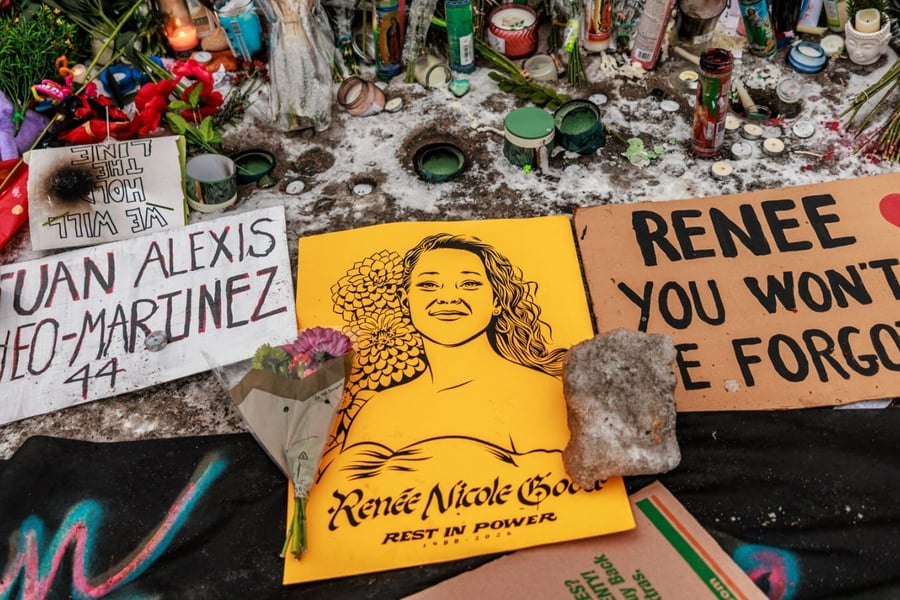
As U.S. Immigration and Customs Enforcement (ICE) continues to lay siege to Minneapolis, with other blue cities around the country bracing for similar crackdowns by an increasingly punitive Trump administration, many have been left to make sense of chaotic protests and state violence through what they see on the internet. And since the fatal shooting of 37-year-old mother Renee Good by an ICE agent on Jan. 7 sent shock waves through the Twin Cities region, a lot of that material has been AI-generated, leading to conflicting narratives of a death that has escalated political tensions nationwide.
In the immediate aftermath, of course, both MAGA and staunchly anti-Trump social media users attempted to use AI to their best advantage. The far right circulated artificial images that appeared to show an overhead view of Good’s car on the street where she was confronted by ICE, which made it appear as if she was trying to run over Jonathan Ross, the federal agent who killed her. They also disseminated a phony video and pictures that purported to show Good and her wife Becca Good celebrating the assassination of the conservative podcaster Charlie Kirk last September. Meanwhile, before Ross had been publicly identified, some ICE critics asked AI models to “unmask” him based on footage in which the lower half of his face was covered. Since the technology is fundamentally unable to perform this task, it merely produced faces at random, sowing further confusion.
But not all of this slop was purely for the purposes of misinformation, or misguided efforts to expose Ross. At least one of the MAGA loyalists arguing that Good’s death was her own fault went to an image generator with a sickening request for a depiction of Ross kneeling on her neck in a pose that recalled former Minneapolis police officer Derek Chauvin’s murder of George Floyd, which set off massive demonstrations against racial police brutality in 2020. Someone used Grok, the model developed by Elon Musk‘s xAI and integrated into his social platform X, to deepfake Good’s bloodied corpse in a bikini. (Access to the bot was restricted last week after it was enlisted to create thousands of nonconsensual sexualized images, and xAI later announced that it had implemented measures to prevent Grok from editing pictures of real people to swap in more revealing clothes.) A particularly bizarre Grok video showed a woman meant to resemble Good being shot in her car and tumbling out of the driver’s seat into the fires of hell.
Still others evidently sought to find common political ground with AI renderings of Good alongside slain pro-Trump martyrs. There was, for example, a doctored picture of Good next to a smiling Ashli Babbitt, the U.S. Air Force veteran and QAnon conspiracist fatally shot by a United States Capitol Police officer as she stormed the the House Speaker’s Lobby during the Jan. 6 insurrection to overturn Trump’s 2020 election loss. The two are superimposed against an illustration of the gates of heaven. An X user, meanwhile, suggested painting a mural of Good and Babbitt together on a building in Minneapolis, mocking up the idea with AI and titling the proposed portrait “A Friendship Forged in Winter Fire.” He added: “One example of what AI is good for, making politically harmonious murals human artists would refuse to make.” In the theoretical mural, Good carries what looks like a Trump sign, though it is partially obscured.
Good could also be found in heaven with Charlie Kirk, in AI-rendered fantasies that imagined them as former political opponents who had reconciled. Multiple artificial images that made the round on Facebook and X show them in the afterlife; in one iteration, Good and Kirk hold up signs saying “He didn’t deserve it” and “She didn’t deserve it,” respectively. Another version has Good holding a sign that reads “I don’t agree with him,” while Kirk’s sign says “—but I don’t hate her.” The series of pictures included images of Good and Kirk embracing and even kissing.
If this content was meant to instill a heartwarming message about coming together despite contrasting beliefs, not everyone deployed it that way. A conservative influencer with a large following on Facebook shared an AI-generated picture of Good and Kirk hugging with this caption: “Guys I’m with Charlie now and my TDS is cured. Trump was right about everything! I’m so so sorry.” (“TDS” is shorthand for “Trump derangement syndrome,” a MAGA term of disparagement for liberals who oppose the president’s agenda.) The same commentator elsewhere posted an edit of Good and her wife as the cowboy lovers from Brokeback Mountain, retitled Fuck Around & Find Out Mountain.
What all these slop examples have in common, regardless of the source or their particular sympathies, is that each is a transparent play for engagement. Whether deliberately provocative or squishy and sentimental, they elicit a strong negative or positive reaction, depending on the viewer. To bad actors, the grim reality on the ground in Minneapolis is simply fodder for low-effort memes and propagandistic distortions, curated for clicks and boosted visibility.
Love Music?
Get your daily dose of everything happening in Australian/New Zealand music and globally.

More and more, it seems that a deluge of such brain rot is the internet’s default response to disturbing, consequential events. Instead of facing up to a dire situation, we bury it in content that precludes any serious reckoning. Which, in turn, may only dull our response to the next crisis. You can call it a race to the bottom, but it’s hard to imagine the possibility of sinking any lower.
From Rolling Stone US

