






























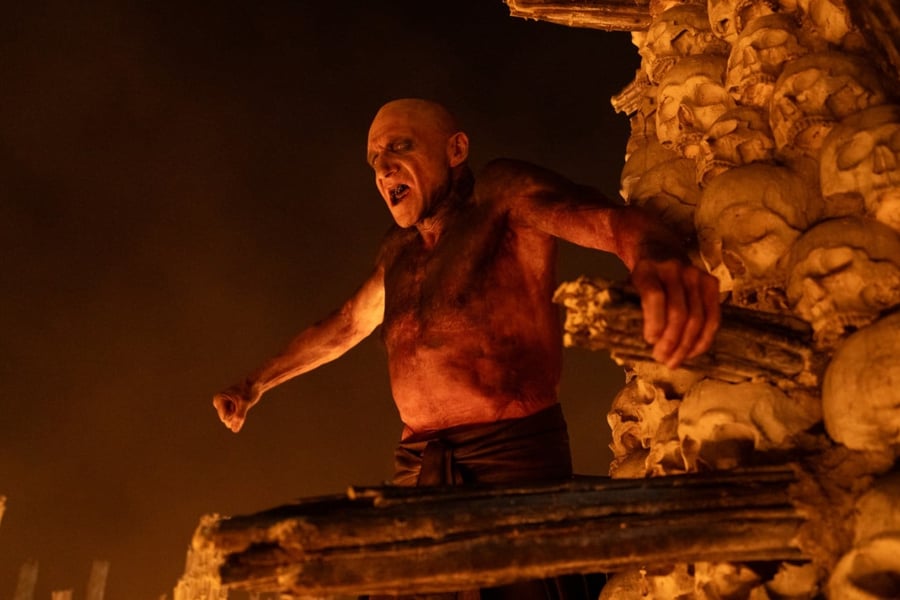
You can see He Who Shall Not Be Named in him — the bald head and a late-act ghoulish pantomime practically begs the comparison, though this dark lord has a nose. There’s a little touch of Odysseus about him too, notably in his posture and his preference for a minimal amount of clothing. Charles Van Doren, Francis Dolarhyde, Lázsló Almásy, M. Gustave, Coriolanus, Hades — all of these characters feel like they’re being briefly channeled at one point or another as well. Movie actors, the kind who get their names regularly above the titles, have a way of bringing bits of their best-known roles to mind whenever they show up onscreen. Squint, and you can even detect the shadow of Commandant Amon Goeth hovering about this man, in the way he holds authority over a manufactured environment reeking of death.
His name is Dr. Ian Kelson, a self-appointed memorialist of the dead. And as played by Ralph Fiennes, he’s the best thing to happen to the 28 Days Later franchise since the Rage Virus.
The latest addition to the series, 28 Years Later: The Bone Temple, has a lot going for it. Having effectively ended one trilogy and kickstarted a new one with last year’s 28 Years Later, O.G. creators Danny Boyle and Alex Garland have established a solid foundation for the next phase of their postpandemic United Kingdom. The momentum of that carries over to this; we had to wait five years for a sequel to the original, a whooping 18 years for a third movie, and only six months for this one. New director Nia DaCosta — the sort of filmmaker who can handle both a continuation of the racially charged Candyman mythology and a radical take on Henrik Ibsen’s Hedda Gabler — brings pints of fresh blood to the proceedings, as well as a keen eye for compositions and an inherent sense of how to sustain tension. Jack O’Connell, fresh from slaughtering half the cast of Sinners, understands that villains are often the most charming characters in stories even when they’re chilling you to the bone (it’s why Satan gets all the best lines in Paradise Lost). He repeats that trick to good effect here. You want sprinting, growling, homicidal maniacs eating brains? Got it. How about philosophical queries into the nature of good and evil? Got that too.
But it’s Fiennes’ good doctor who provides the backbone (not to mention the literal bone temple of the subtitle) and the beating heart of this new chapter, and we have the 63-year-old actor to thank for that. Kelson was someone spoken of in hushed whispers for most of the first movie, some larger-than-life figure whose legend both proceeds and eclipses him — he’s the Harry Lime of the 28 Years Later world. And like Orson Welles’ capitalist critic of cuckoo clocks, he finally shows up in Act Three and helps shepherd the story to it logical, mournful conclusion. The temple Kelson has constructed is an elaborate memento mori constructed out of the skulls, femurs and spines of the dead, an art installation-slash-3D-graveyard doubling as a tribute to those who shuffled off this mortal coil. The Bone Temple is itself a testimonial to what Fiennes can do with a role like this: take a highly conceptual character on the page and enrich him, enliven him, deepen the intent, give a tragic recluse both gravitas and pathos. Plus he dances to Duran Duran‘s “Rio” while doused in blood and iodine. Give him an Oscar just for that.
DaCosta’s addition to the series runs two parallel narrative tracks: The first involves the Jimmies, those marauding blondies we met in the coda of the previous movie. Spike, the young hero of that entry played by Alfie Allen, is essentially jumped into the gang and forced by its leader, Sir Jimmy Crystal, to participate in their brutality. He’ll spend the rest of the movie trying to escape the clutches of O’Connell’s golden-tressed Satanist in a track suit. Most, if not all zombie movies — and the adjacent subgenre of “contagion” horror that the 28 Days Later films helped revolutionize — tend to operate on a single notion: stay vigilant against the walking, chomping dead, but watch out for your fellow human survivors. They are the ones who will truly fuck you up. The lost boys and girls that Sir Jimmy has assembled and refers to as the “fingers” of his fist are a prime example of what happens when a postapocalyptic power vacuum opens up and our worst angels end up filling the gap. Even Crystal’s second-in-command (Eleanor the Great‘s Erin Kellyman, once again proving that she’s a next-gen someone-to-watch), who still nurtures a tiny ember of empathy, is capable of a stunning viciousness when needed. Desperate times, etc.
The second involves Kelson and his growing bond with the infected “alpha” Samson (Chi Lewis-Parry), which gives the film its single ray of hope in the darkness and an excuse to drop a rom-com montage in the middle of the mayhem. [Possible spoilers ahead. You’ve been warned.] The hulking brute still rages in the wilderness, liberating the heads and spinal cords from the bodies of unlucky passerbys. The doctor still protects himself with blow darts dipped in morphine, which pacifies the alpha enough to allow safe passage. Except an act of kindness and the euphoric effects of the opiate have made Samson take a shine to Kelson. The giant keeps returning for more drugs. The doc, in need of companionship, keeps giving him doses. “Peace and respite… nothing wrong with that,” Kelson murmurs to his new friend, as the two of them sit drugged up by a river — a shot that DaCosta captures from behind, as if she was observing them from a distance. It’s one of the more moving moments in a film that isn’t shy about showing people being skinned alive.
What sticks in our mind after two viewings, however, is the way that Fiennes gently intones “peace and respite,” embedding an entire history of pain in three words. Ditto the sequence in which Kelson, stripping naked after a day of hunting for more resources for his memento mori, sits exhausted on his cot; the close-up shot of Kelson running his hand over his bald pate feels like a direct homage to another damaged, unstable king of the wild. (When we talked to Garland for a piece last year, we floated the idea that Kelson reads like a cross between Albert Schweitzer and Colonel Kurtz. The screenwriter confessed that the famous doctor who tended to the sick in Africa had not crossed his mind — but he was 100-percent thinking of Kurtz when he wrote the character.) Kelson is also a huge Duran Duran fan, which allows Fiennes to sing a number of the band’s hits; you truly have not lived until you’ve seen the Schindler’s List actor teaching a 6′ 9″ virally infected psychopath to boogie to “Ordinary World.”
Love Music?
Get your daily dose of everything happening in Australian/New Zealand music and globally.

The two story strands eventually become intertwined, leading the Jimmys to Kelson’s boneyard and once again leaving bodies on the ground and survivors on the run. There is a sequence involving pyrotechnics, pancake make-up, and Iron Maiden’s “The Number of the Beast” that defies description; trust when we say that, even taken out of context, it’s worth the thrice the price of admission. Again, you feel like Fiennes is giving Voldemort a lot in this set piece.
But the manner in which The Bone Temple allows enough space for the star to invest a myriad of different shades and tones within his character’s arc from loner to nurturer, fellow survivalist to friend of those who’d do him harm, is enough to draw the interest of those who appreciate great performances no matter where they pop up. To say that Fiennes is a great actor is to not say very much at all — we take his brilliance in prestige projects, Shakespearean and other high-lit adaptations, and even pulpy pope fiction for granted. Yet there’s something about his take on Kelson, the unique way he’s threading tenderness and trauma through a recognizable madness (and vice versa), that makes you sit up and lean in. This 28 Years Later entry also contains a coda, cuing up the next installment in a way that makes the film feel like a bridge between pushing the story forward and servicing the fans. Fiennes makes it feel like a tale of maintaining humanity in times when the horror, the horror threatens to overwhelm. Kelson cannot save the world. The artist portraying him, however, makes you feel like he’s saved the series from collapsing under its own genre-legacy weight.
The Bone Temple is out in Australian cinemas today.
From Rolling Stone US

