






























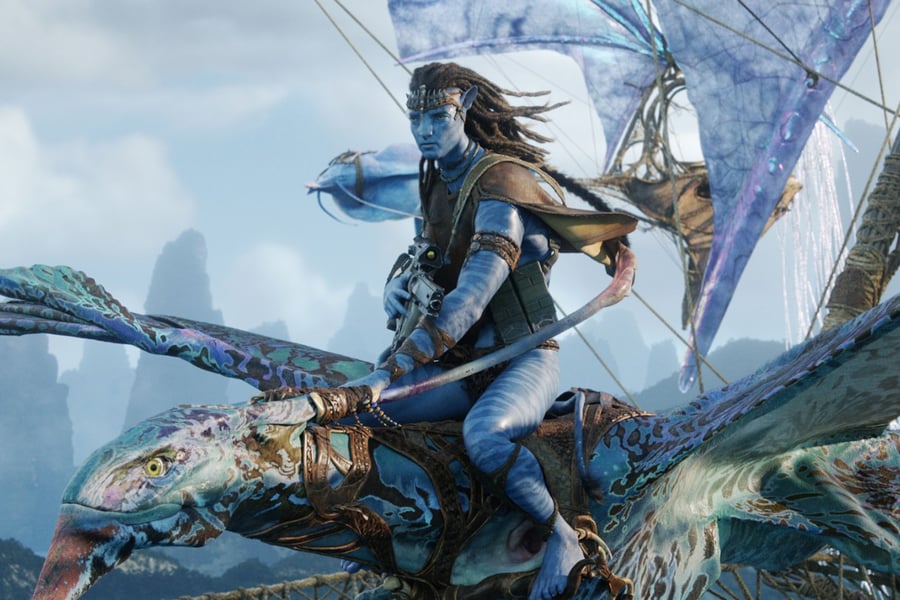
There are two dates that are considered sacred to movie lovers, film historians, and those who diligently chart the evolution of the seventh art. The first is October 6th, 1927, when Al Jolson told the audience “you ain’t seen nothin’ yet!” and The Jazz Singer officially ushered in the sound era. The second is December 9th, 2009, a.k.a. the premiere of Avatar, when the general pubic could finally bask in what James Cameron had conjured up in the name of turning the fantastic into the eerily photorealistic, and hear characters breezily throw around the word “unobtainium.”
We’re kidding (or are we?!), yet you can’t underestimate how seismic this blockbuster was in terms of technological breakthroughs any more than you could blow off its box-office bona fides — it remains the highest grossing movie to date. Nor could you deny that all that hyperpixelized 3D sound and fury was being utilized to tell a story that felt as elemental and simplistic as a cave painting. It was part of Avatar‘s global appeal as much as the overwhelming visuals; love, war, and the colonial ransacking of resources in the name of corporate bottom lines tend to play universally. For some, it also had the feeling of several philharmonic orchestras being assembled to play an extravagantly Wagnerian rendition of “Mary Had a Little Lamb.”
Avatar: The Way of Water (2022) made up for that aspect by quadrupling the in-franchise mythology and pioneering underwater performance-capture filmmaking, thus combining three of Cameron’s passions: deep-sea exploration, developing state-of-the-art tech, and putting actors through hell. Everyone now expects the writer, director, and King of the World to reinvent the wheel every time out, yet three films into what he’s said is a five-film series, Avatar: Fire and Ash suggests that he’s happy to simply settle into a groove for a bit. There are more stand-offs between the natives of Pandora and the “sky people” who want to ransack the planet, more family drama and ecological strife, more firefights in the heavens and on the All-Mother’s earth, more blue-skinned teens calling each other “bro.” Familiarity doesn’t breed outright contempt here, but it certainly doesn’t inspire shock or awe, either. The story continues, while Cameron goes to great pains to give the people what he believes they want: the most expensive three-hour video-game cut scene ever made. Mission accomplished.
Abandon hope, all ye who do not remember every single detail of the previous two films or possess a Ph.D in Avatar Narrative History 101. Part Three throws viewers right into the fire, with the Sullys collectively mourning the loss of their eldest child at the end of The Way of Water. Their collective grief is interrupted by the fact that the resident human among them, Spider — played by Jack Champion, whose name sounds like a James Cameron character — is in need of help ASAP. The batteries on his oxygen mask have a habit of cutting out at inconvenient moments, so Jake (Sam Worthington) makes an executive decision: The kid needs to return to his kind. His wife Neytiri (Zoe Saldaña), his son and Spider’s best bro Lo’ak (Britain Dalton), their adopted daughter Kiri (Sigourney Weaver), and the Sullys’ youngest, Tuk (Trinity Jo-Li Bliss), don’t want him to leave. Spider’s whole vibe is very “Whoa, think I took too many ‘shrooms during Phish’s second set,” and his survival may be at risk, but this “pinkskin?” He’s still family.
The idea is that they’ll transport Spider back to the base where the Na’vi-friendly humans live via caravan, with members of the reef tribe known as the Metkayina accompanying them for safety. It will be an adventure, Jake says. It will also be an ambush. Because there’s this other tribe, see, called the Mangkwan, and because their home terrain was in the path of a raging volcano, they’ve essentially become warring godless heathen. Led by Varang (Oona Chaplin, Charlie’s granddaughter), they swoop down on the group’s blimp-like skyships and give Cameron & co. the chance to break up the handwringing by staging a massive attack sequence. The Sullys are split up. Spider nearly asphyxiates to death, until Kiri connects him to the spirit that connects all living things on Pandora and voila, the kid with the dreads can survive without a mask now.
Meanwhile, Spider’s biological dad, Colonel Miles Quaritch (Stephen Lang) — tough-as-shit marine, former dead person resurrected as a human-Na’vi “recombinant,” big blue bad guy — still wants to capture Jake for being a “traitor to humanity.” If he has to form an alliance with Varang and Mangkwan to make that happen, and if said alliance means he’s going to get horizontal with this unhinged kindred warrior, so be it. Plus: Evil scientists, venture capitalists, and shorts-wearing former corporate bigwig Parker Selfridge (Giovanni Ribisi) all want to study Spider to see if they can replicate his ability to breath Pandora’s air, which would be gamechanging in terms of strip mining resources en masse. Also: The tulkun, those whale-like creatures with their own tribal culture, are still being hunted for their brain juice, and still stick to their pacifist ways; their exile of a member that fought back has Lo’ak in a tizzy. And: the Metkayina remain skeptical that Jake is the one meant to unite all tribes, and fear his presence will once again bring enemies to their home.
Lots going on here subplots-wise, in other words. Lot of eye candy being served up, in great big scoopfuls. A whole lotta lead-up to a huge, epic battle that takes up the bulk of Fire and Ash‘s final quarter, cross-cut between skirmishes in the sky and aquamarine melees, punctuated by huge beasties going full kaiju on ships and mecha-suited troops. There are births and deaths and the reminder that, for all of the digital blitzkrieg on display, the performance-capture technology that Cameron helped both upgrade and refine remains the secret weapon of this whole endeavor. Some actors utilize this in a way that feels both thrilling (Lang and Chaplin create the best villainous double act since Boris and Natasha) and extremely impressive (God bless Weaver, who does such an incredible job channeling an emotional 16-year-old that you forget the character isn’t being played by an adolescent). Others are merely forced to say lines like “The fire of hate leaves only the ashes of grief,” or “When you ride the beast, you become the beast,” or “We do not suck on the breast of weakness,” and pray the digi-touch-up team ensures their characters keep straight faces while delivering such howlers.
Love Music?
Get your daily dose of everything happening in Australian/New Zealand music and globally.

Cameron has said that the fate of Chapters Four and Five will depend on the financial success of Fire and Ash, and that if necessary, this could function as the final movie of a trilogy. But who the fuck are we kidding here? This is not the huge leap forward that the previous Avatars were — there’s a distinct middle-child feel to all of this, and the filmmaker’s insistence that the next two movies are gonna be out of this world only heightens the feel that this one’s here to get you from one point to the next. But it’s still an Avatar movie, which means it will still likely make a gajillion dollars no matter what, and we’ll still be left wondering, either reluctantly or breathlessly, what happens next. You can crow about the fact that it’s merely a going-native narrative dressed up in fancy 1’s and 0’s, or that this I.P. leaves little to no cultural footprint, or that its hodgepodge of Joseph Campbell and Alan Watts and mix-and-match Indigenous cultural myths is somehow way too much yet not nearly enough. More are coming. It’s just a question of when.
The irony is that the Avatar films are the products of a true visionary who’s figured out a new way of storytelling without having a new story to tell, and has simply made a bigger, bolder, more bleeding-edge campfire around which to sit while the old warhorse origin tales are trotted out. These movies have also bled a lot of viewers’ love of spectacle dry in the process, to the point where even a mammoth production like this feel like business as usual. You may feel, with its immersive 3D set pieces and screensaver imagery blown up to IMAX proportions, that you’re entering a bold new world. But transportive is not the same as transcendent. The piles of ash here looks and sounds phenomenal. What you would not give to feel some actual fire burning behind all of this.
From Rolling Stone US

