




























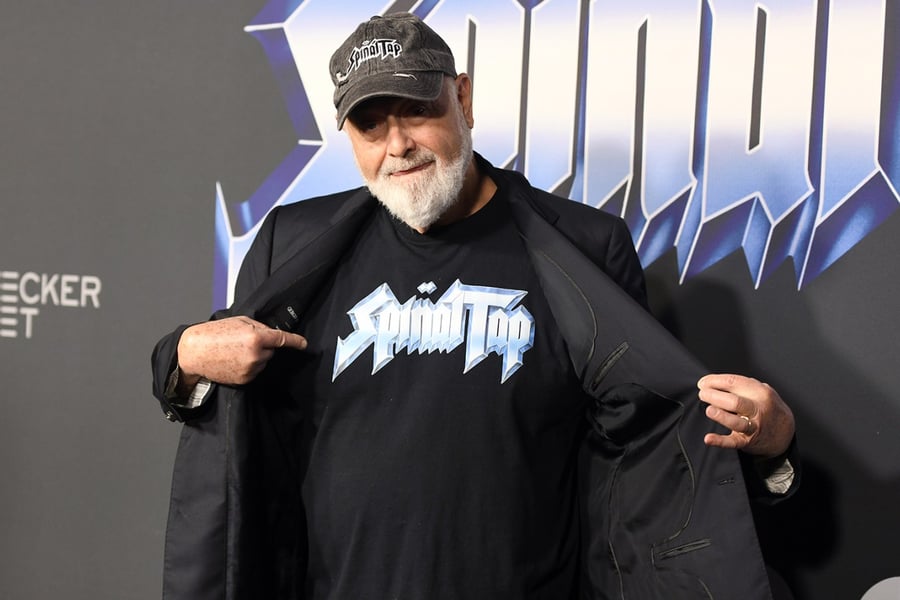
“We’ll talk soon,” Rob Reiner promised at the end of a hour-long remote podcast interview in May. “Hopefully we’ll see each other in person.” Reiner and I never spoke before that day, but it felt like I had known him my whole life — like any pop-culture obsessive of my generation, I essentially had. Our conversation was supposed to be about Spinal Tap II: The End Continues, but it ended up roaming all over his life and career. In the wake of Reiner’s tragic and sudden death this week, here are some highlights from that interview. (To hear the whole conversation, listen on Apple Podcasts or Spotify, or just press play below.)
What do you make of Trump threatening Bruce Springsteen after Bruce called him “corrupt, incompetent, and treasonous?”
First of all, Bruce Springsteen is a hundred percent right. You have to be a moron to not think that everything that Bruce Springsteen said is true. And there’s nothing that Donald Trump can do to him unless he’s able to turn this country into a full-blown autocracy — which he’s trying to do. And because he’s so dumb and he’s such an incompetent person he’ll fail, just like he’s failed with everything he’s ever done in his life.
I’ve said this a million times. He’s failed at everything. He’s been bankrupt six times. The only thing that he hasn’t failed at is convincing people he’s not a failure. And he’s done that really well. He knows show business, he knows the media. He knows how to push disinformation. He was smart enough to get Truth Social. He knows how to monetize things. He knows how to do all that, but knowing how to take a 250-year democracy and turn it into an autocracy? He’s gonna fail. But we are gonna have to fight. We’re gonna have to fight like crazy to preserve this, because I’ll be damned if my uncle who was part of D-Day and fought in 11 major battles, and my wife’s mother who was in Auschwitz and lost her entire family in Auschwitz, is gonna be… Millions of people died so that fascism wouldn’t come to our shores, that we’d preserve our democracy. Eighty years later we’re faced with a possible fascist takeover. People are gonna fight hard to make sure that doesn’t happen.
We have to keep Trump’s feet to the fire. But for the countries that have become autocracies, for the most part, it takes years to start changing the constitution, to start changing the electorate, to make the disinformation take hold. It’s a little easier now with social media, but he’s trying to do it overnight, and I don’t think they’re gonna be successful.
So many of us rewatch Spinal Tap dozens of times. It’s one of the movies I’ve seen the most times. It’s that kind of movie.
A lot of people say that. Years ago, when I first met Sting, he told me that he watched it all the time on the tour bus, and a lot of bands do that. He said, “I’ve seen it over and over again. Every time I watch it, I don’t know whether to laugh or cry.” I thought it was a perfect description for people who are in that world.
How often would you go back to it?
Listen, I spent all the time working on it, nine months cutting it, and we did DVDs and commentary and all of that. I’ve seen it a lot, but I haven’t seen it in many years. We watched it recently, just to remind ourselves of things that happened, but I hadn’t seen it in decades, I think, since we first started working on it.
But to me, every film I’ve made is like a home movie, because when I’m watching it I’m thinking, “Oh, I remember on that day this happened or that happened.” You don’t get drawn into the film the way. Although I gotta say, recently they screened a couple of my films at the Turner Classic Movies Festival, Misery and The American President. And Misery — I watched it, I hadn’t seen that in a long time. I said, “This is a pretty good movie.” There’s real characters, there’s a plot, there’s great dialogue, and it’s like a full meal. And now, I don’t know, a lot of people are making different kinds of movies.
Love Music?
Get your daily dose of everything happening in Australian/New Zealand music and globally.

That one is indeed a hell of a movie.
The ankle break is rough.
The book is worse, though!
In the book she chops his foot off.
That was a smart change. People would’ve been leaving the theater.
It’s interesting, because I didn’t change it for that reason. I changed it because I wanted him to come out of the experience not diminished. Not really diminished. The whole idea was that he was fighting against his fan base to do something different, to break out of that. Yes, he was going to experience this horrible time with Annie Wilkes, but I wanted him to come out whole. And so that’s the reason I did it. Not because “ooh, it’s more gruesome” or “it’s less gruesome.”
How’s this for a transition: Much like James Caan’s character, you were trying to change people’s ideas of what you were capable of and moving into new areas. And Spinal Tap was your first movie as a director. You had this interesting situation of being famous enough as an actor to get the meetings, but then having trouble convincing people that this was the right thing.
At that time, there was no cross-pollination between movies and television. If you had made your bones in television, that’s where they wanted you to stay. There were no actors who crossed over and made movies if they were in television. Directors, same thing.
It changed completely around my time when there was me, there was Ron Howard, there was Barry Levinson, and then Penny Marshall and Jim Brooks and Danny DeVito, and we had all come out of television and we made that leap. And once that happened and there was some success in some of these movies, then it was OK. But at the time I was doing Spinal Tap, it was like, “What has he done? He doesn’t direct. He’s not a director.”
You really were a creature of rock & roll before this movie. You were deeply embedded in the Laurel Canyon scene of the Sixties.
I was right in the middle of all of that. I’m the first generation that grew up on rock & roll. And so in the Sixties, if you lived in Los Angeles and you were part of the art scene, you were in Laurel Canyon. I lived in Laurel Canyon for a couple of years. And when I started performing with the Committee, which was an improv group that came from San Francisco and they had a troupe in L.A., there was a great crossover between the rock & roll world and our world.
Janis Joplin used to come up onstage with us to improvise. We’d go to Barney’s Beanery and there was Bobby Neuwirth, who worked with Dylan, and then the Mamas and Papas would hang out. Cass Elliot would come to the house. And as a matter of fact, Cass’ sister, Leah, was married to Russ Kunkel — Russ was our first drummer in the first iteration of Spinal Tap.
And then I also went to college with Jim Morrison and Ray Manzarek from the Doors, and they were a little ahead of me in film school, but I would go to see them at the Kaleidoscope. It was down on Sunset Strip. I watched the show and then there was Jim Morrison leaving the stage halfway through the show. And I went backstage after and I said, “Ray, what’s the story here with Jim?” And he said, “We finish the set without Jim a lot these days.” Jim would always just wander off.
And then I was at a party once when Joplin and Morrison got into a fight and she took a Jim Beam bottle, smacked him over the head, and he passed out on the pool table. I was in that world, just hung out with all those people. Steve Miller from the Steve Miller Blues Band used to come in all the time to the Committee. So yeah, there was a real great mix between improv people and rock & roll.
How good was Janis Joplin at improv?
She wasn’t that good. [Laughs.] She wasn’t that good, but she was fun. She had fun up there and we had fun with her. She went with a guy who was a good friend of mine up in San Francisco. My friend Carl Gottlieb, who’s also in the Committee, he shared an apartment right across from Ghirardelli Square up in San Francisco. And this guy, Milan Melvin, who was a friend of ours, he went with Janis.
I put this at the top of my credits, when I look at my CV, is that I overheard her and Milan making love. That to me ranks right up there as a great credit. And I was in Haight-Ashbury in the Summer of Love in ’67 and all that stuff.
I’m thinking about your experience with rock & roll documentaries before Spinal Tap. Don’t Look Back must have been one of the first serious ones that you saw.
Absolutely. I looked at everything. I steeped myself in that world. So I looked at Don’t Look Back, I looked at The Kids Are Alright about The Who. The Song Remains the Same was Led Zeppelin. And I looked at, obviously, The Last Waltz over and over again. The idea that I got of the documentarian inserting himself into the film — I got from that film, ’cause Marty Scorsese interviews the Band. And then I took the name Marty DiBergi, which is a combination of Scorsese and De Palma and Ingmar Bergman and Fellini. I meshed them all together.
And Marty Scorsese — he didn’t like it at first. When he first saw it, he said, “Ah, you’re making fun of me.” But now he’s come to really love it.
There’s some unintentional comedy in The Last Waltz with the seriousness of Scorsese versus the sometimes ridiculous things these guys were saying.
In all fairness to Marty, listen, I love the Band too. I’m a huge fan of the Band, and I got to know Robbie Robertson a little bit, which was nice. But Marty loved the Band and he was serious about it. He really did love them and there was no comedy there. He wasn’t trying to have any fun.
But we all, the four of us [me and Christopher Guest, Michael McKean, and Harry Shearer], realized that rockers have a tendency to glorify or philosophize or pontificate about the importance of the work they’re doing. And some of it is very important in terms of music and what it says, especially at a time like the Sixties and there’s a certain zeitgeist. But sometimes they can be a little bit too pontificating, take themselves a little too seriously.
You essentially took that very sincere Scorsese persona from The Last Waltz and applied it to Spinal Tap, the dumbest band imaginable.
Yes, absolutely. The fact is, the four of us were satirists. We have other sides to us, but we’re satirists, and satirists make fun of anything. And in this case, we’re making fun of something we actually really love. We love rock & roll, so it’s hard to find that balance between showing something that you love and also making fun.
And one of the things that was very tough for me in making that film was that I feel like you have to have some kind of emotional something in the film, in order to ground it in some kind of reality. And satire and emotion are oil and water. They really don’t want to play nice together.
It was tough to find that, just that little bit of emotion, and we did it. We used the relationship between Nigel and David and the fact that they knew each other since they were kids, and that there was some tension and there was something going on between them and was that gonna hurt their friendship? That was the thing that we played upon.
You have a term you use — schnadling. Where did that come from?
Schnadling is what we call improvising. When you can do shtick back and forth with somebody. In order for these improv movies to work, you gotta get the horses, the people who really know how to schnadle. And then it’s easy. Because people said to me, “I can’t believe the first movie you made has no script.” I said, “Yeah, but if that’s what you’re comfortable doing, if they’re comfortable schnadling, then that’s easy.” That’s easy. Much harder to do with a script.
With the amp going to 11 scene, Christopher Guest had no idea you were going to challenge Nigel’s logic.
No. I also find that when I put Chris in a corner, he’s great. I’ll challenge him on something and then that blank look comes on his face and I know he’s thinking, “What do I …” It forces him into a place that’s good.
In your Wolf of Wall Street cameo, were you improvising a lot?
Yes. Sometimes we were. That was a great thing with Marty, too. He would let you go. But he was smart enough to know — it’s like anything; if you’re with somebody who can schnadle back, it’s great. In the scene with Jonah Hill where I said, “Look at this bill, it’s $20,000,” and he says, “We ordered sides.” And I said, “What are these sides? What do they do? What do they, cure cancer?” And he says, “Yes, these sides could.” So that was improvised, because you’re just with somebody that you can do that.
There’s so much specificity in Spinal Tap. It makes total sense that Fran Drescher’s character Bobbi Flekman was based on a real person.
The guys knew her. I didn’t know her, but the guys knew her, and she was that character. And when Fran came in, it was like, “Oh, Bobbi Flekman just walked in the office.”
Where did the original joke of the many dead drummers come from?
Look at Keith Moon and John Bonham. And the craziest one was, we had a guy dying in a bizarre gardening accident. And then you look at Toto, and Jeff Porcaro died gardening. It was like, what? It’s like life imitating art imitating life.
And my favorite thing is, there was a tour of Black Sabbath, they were playing without Ozzy. And they went on tour with a Stonehenge theme. And our film came out like a week after they started touring. And they thought we stole it from them. It was a perfect rock & roll dumb moment to think that we could shoot, edit, and get it into the theaters in a week.
Christopher Guest really took up the mantle of putting real emotional elements in these satires — look at A Mighty Wind.
I think Chris always was OK with that. The rest of us had arguments and discussions because it wasn’t a pure satirical documentary. For the most part it is. That’s me a little bit pushing my softer side, which I have. And listen, when I made Princess Bride — talk about a mixture of weird stuff. That’s the most oddball movie you can imagine because it’s got satire — “Never get involved in a land war in Asia” — and it’s got romance, and it’s got swashbuckling adventure. So it’s a weird kind of mix. You can do it, I guess.
There’s so much to your career. But Spinal Tap, it really does stand out. It was your first movie. It changed comedy for decades to come. How does it rank for you within your filmography?
It’s like we say as parents, we love all our children. Even the black sheep, even when I made North. I loved that movie, too. Listen, obviously, it’s made its way. I have three films now in the Library of Congress, put in the National Film Registry: The Princess Bride, this one, and When Harry Met Sally …, I think.
Stand By Me means emotionally the most to me, for a personal reason. Certainly Spinal Tap — listen, when you can make it into the Oxford English Dictionary, you know that’s going somewhere.
I love the fact that I’ve made movies that people quote. They quote “You can’t handle the truth.” My favorite one is, I made this movie Bucket List years ago. And everybody thinks that’s a term that’s been around forever. It was made up for the movie! So incredible. People all the time saying, “Ah, that’s on my bucket list.” Thinking that’s been around forever. It started with the movie and nobody understands that.
I don’t think a week goes by where I don’t quote something from one of your movies, and especially Spinal Tap.
This is my favorite: “There’s a fine line between stupid and clever.” That’s my favorite line of all. Because there is! There is a fine line between stupid and clever.
From Rolling Stone US

