





























Just a few weeks ago, the Republican Party was ripping itself apart as factions moved to either distance themselves from Nick Fuentes, the 27-year-old white nationalist streamer, or to loudly announce they would never bow to the woke mob demanding they disavow the openly racist, proudly misogynist, Holocaust-denying Hitler fanboy.
The outrage cycle is apparently over now, and Fuentes has come out on top: Instead of being sidelined by the uproar that erupted after his appearance on Tucker Carlson’s show in October, Fuentes is now being courted by some of conservative media’s biggest names. Last week he appeared on Alex Jones’ Infowars and Steven Crowder’s podcast Louder With Crowder. Today he’s scheduled to sit down with Piers Morgan, for his YouTube show Uncensored.
The latest uproar fits a pattern for Fuentes, a merchant of young white male rage. He has not only survived repeated attempts to cancel him, dating back to his days as a college freshman, but seems to grow more emboldened and attract an even larger audience with each attempt to make him go away. (Fuentes did not respond to an interview request.)
The onetime Ted Cruz fan with what he once described as “off the shelf” Republican views has become so popular as a white nationalist, woman-hating, Charlie Kirk-antagonizing influencer that even the White House is apparently shaking in its boots.
Whether Fuentes’ views are worthy of condemnation is not really a question. He’s called Hitler “really fucking cool” and cast doubt on the Holocaust, saying there was no way to bake “6 million cookies” in five years: “The math doesn’t add up!” After breaking onto the national scene as a figure at Charlotteville’s Unite the Right protest, he argued that life was better for Black Americans under Jim Crow. (“They had to drink out of a different water fountain? Big fucking deal. Oh no, they had to go to different schools! Who cares, grow up.”) The self-described “proud incel” has also said rape is not a big deal, women are too emotional to make political decisions, and he celebrated Donald Trump’s defeat of Kamala Harris by tweeting: “Your body, my choice. Forever.” (This is merely a small sample.)
There was a moment, a few weeks ago, when the GOP appeared poised to unite in a stand against him. Cruz called Fuentes a “poison,” and House Speaker Mike Johnson said it was a “mistake” to platform him. Commentators Ben Shapiro and Mark Levin piled on. And Heritage Foundation president Kevin Roberts was nearly pushed out of his job, under fire from former Senate Majority Leader Mitch McConnell and employees at the right-wing think tank, for defending Carlson’s decision to host Fuentes.
But a funny thing happened next: The leaders of the Republican Party shrugged the whole thing off. “You can’t tell him who to interview,” Trump finally said of Carlson in November, after weeks of silence on the subject. “If he wants to interview Nick Fuentes — I don’t know much about him — but if he wants to do it, get the word out. Let him, you know, people have to decide.”
Love Music?
Get your daily dose of everything happening in Australian/New Zealand music and globally.

Asked about Fuentes himself — and what his role should be in the conservative movement — Trump was circumspect, offering no opinion at all. He also brushed off a question about having dinner with Fuentes at Mar-a-Lago in 2022, after Kanye West brought him as a guest. “I didn’t know he was coming,” Trump claimed, adding matter-of-factly that “people are controversial — some are, some aren’t.”
“Thank you, Mr. President!” Fuentes posted after Trump declined to bash him.
Trump weighing in at all was notable, considering how studiously the White House has avoided the topic of Fuentes altogether. As The New York Times reported in September, “Current and former members of the Trump administration as well as outside advisers would not be quoted for the record about Mr. Fuentes out of fear, they said, of inviting online attacks from him and his zealous followers. Three of them mentioned the sudden ubiquity of Fuentes-related clips circulating in their social media feeds.”
Vice President J.D. has also been conspicuously quiet on the subject. In the midst of the Republican flamewar over Fuentes’ Carlson appearance, he tweeted, “The infighting is stupid. I care about my fellow citizens — particularly young Americans — being able to afford a decent life, I care about immigration and our sovereignty, and I care about establishing peace overseas so our resources can be focused at home. If you care about those things too, let’s work together.” (Fuentes gleefully celebrated this non-disavowal too, explaining that Vance was caught in “the groyper squeeze,” wanting Fuentes’ far-right supporters’ votes but feeling pressure from donors to distance himself from Fuentes’ views.)
His success can, in a sense, be attributed to Trump himself: More than any other young conservative figure operating today, Fuentes is a student of the president and the conservative media ecosystem that rejected him before it embraced him. Fuentes grew up in La Grange Park, Illinois, a suburb of Chicago. At the beginning of the 2016 election, the high school senior and student body president was a committed Ted Cruz head, canvassing for the Texas Republican ahead of the Illinois primary. But something in him shifted after Super Tuesday.
“I said: I could get behind Trump because he’s a winner. He’ll win for our side. That was the first big thing,” Fuentes explained to Carlson. “Then as I listened to him more and more, his speeches and his rhetoric, I started to think about immigration” — a subject he says he, having grown up in a “95 percent white suburb,” hadn’t given much thought to in the past.
It was not Trump, but Mark Levin — who, today, is the country’s second most-popular conservative radio host, after Sean Hannity — whom Fuentes credits with putting him on the path to radicalization when he was still in high school. “I’ll never forget one show, he goes live and he says, ‘America is becoming a majority nonwhite country. Does anybody think that’s a good idea?’ I was thinking to myself, yeah, that actually doesn’t sound so good,” Fuentes told Carlson. “I didn’t really even think that America was becoming a majority-minority like that.”
“You were radicalized on race by Mark Levin?” Carlson asked.
“Yes,” Fuentes said. “He planted the seed, at least.”
Levin has denounced both Carlson and Fuentes, who he called “little Adolf.”
“Everybody is not worth debating and everybody is not worth platforming — neo-Nazis, Klansmen, racists, bigots,” Levin said on his show on Oct. 30. “These aren’t policy disputes. These aren’t white-paper issues. These aren’t debates about principle.” (Levin did not respond to a request for comment from Rolling Stone.)
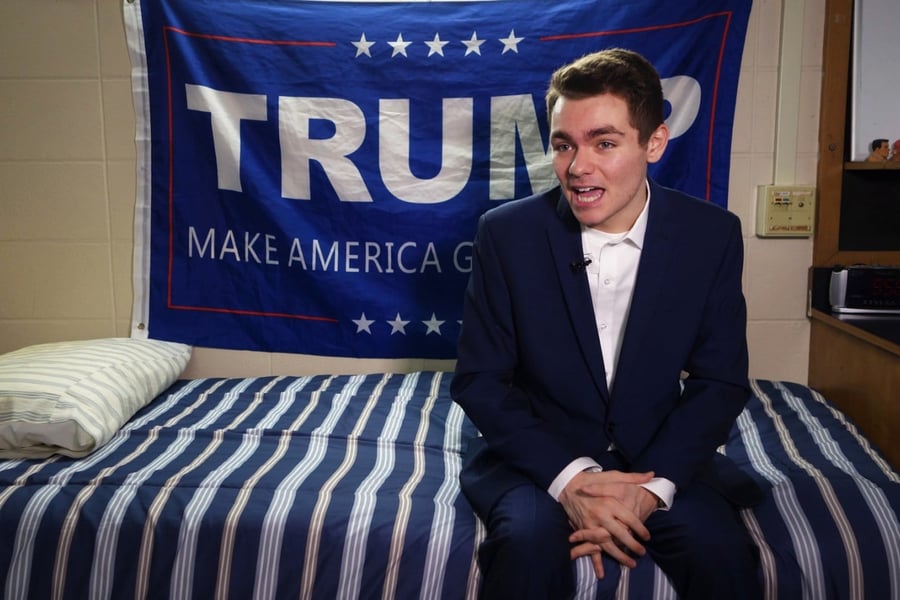
Fuentes left Chicago for Boston University, where he quickly distinguished himself as the kid in the MAGA hat railing against “multi-cultural movement in America.” Within a couple of months, he became a recognizable character on campus — no small feat, at a school with more than 30,000 students — and a magnet for reporters looking for Trump supporters to interview.
In fall 2016, Fuentes shared his enthusiastic support for the Republican candidate with several local outlets, including a video recorded by the campus newspaper, BU Today — an interview that solidified his notoriety on campus.
The BU Today story “brought him negative attention. It honestly got to the point where people were regularly threatening him with violence online, on the Facebook group, some in-person,” says another former BU student, the then-president of BU’s libertarian campus group. (He asked that his name not be used in this piece). The online vitriol — the kind directed at Fuentes directly — bothered the Young Americans for Liberty chapter president, who reached out to Fuentes and offered to host a debate about the 2016 election between Fuentes and another student.
“The whole point of college is to get exposed to opposing ideas and consider other points of view and just engage with them intellectually, not violently,” says the YAL president, who asked that we not share his name in the piece since he has experienced his own backlash for a mere brush with Fuentes a decade ago. “Everyone associated with him at that point was considered to be like platforming white supremacy or platforming hate speech. I just took the view that censoring people is the last thing you should do — especially at an institution like a college.”
The debate “ended up becoming this big, hyped-up event with a lot of buzz around it,” the YAL president says. There was so much interest that it was moved to a large auditorium on campus, where a few hundred people showed up to watch Boston University’s then-student body president, Jake Brewer, debate Fuentes onstage. The YAL president remembers Fuentes’ dad showing up to support him. “I’m sure his dad was probably worried about him getting all of these threats.”
Kassy Akiva, now a video journalist at The Daily Wire, was at the debate, and she recorded the whole thing. “She was very impressed with Nick and she sent it directly to Ben Shapiro,” the YAL president remembers. Shapiro, Fuentes said to Carlson, took an interest in him, and Fuentes was under the impression he was on his way toward a lucrative future as a conservative commentator, but he says that dream was snuffed out quickly after Fuentes criticized Israel online.
Shapiro and Akiva, Fuentes told Carlson, “started paying attention to me. And the more critical of Israel I was, I started to get this really intense pushback from both of them and from a lot of the people at Daily Wire.… All of them one day said, ‘You’re done. We’re blocking you. We’re never going to speak to you again. We’re never going to have you on our show.’”
Akiva, for her part, has disputed the idea that she and Fuentes fell out over his criticism of Israel. “We fell out because I thought he was being unnecessarily nasty to people,” she wrote on X. “Nick has been retelling this story recently to attack Ben Shapiro and claim that being ‘betrayed by friends’ somehow radicalized him. It’s never been true.” (Akiva did not respond to a request for comment.)
Fuentes’ version of his own story is a classic comic-book villain backstory that mirrors Trump’s rise: Cast out of the club he desperately wanted to be part of, Fuentes struck out on his own, personal grievances fueling a nightly livestream that, over several years, amassed a huge audience. Today, he has more than a million followers on X.
The recent efforts to push Fuentes out of the public square felt like déja vu to the YAL president. “It seems like every time he’s censored or goes away, he comes back bigger — that’s just what I’ve seen for the past 10 years.” Like Trump, he still believes challenging Fuentes in the open would be more effective than trying to shut him out. “Getting those ideas out in the open and actually enabling him to be confronted by someone like Tucker, or whatever shows he’s going on, I think can only help moderate his views … instead of just going on his own show every night, where it’s just him talking.”
For better or worse, Fuentes is definitely getting out there more now. Whether getting out there will moderate his views remains to be determined.
“It sort of seems like he tried to have two paths — one more mainstream, and one fringe alt right,” the other BU student says. “The mainstream wouldn’t have worked for him, he just would have been lost in a sea of conservative grifters. He went as far out there as possible, and found a group of people — founded? spearheaded? — an entire movement. It’s, unfortunately, sort of impressive.”
That movement is now big enough that Trump and Vance are both being careful not to incur its wrath. Fuentes, meanwhile, has not been shy about criticizing the Trump administration, declaring in September: “Trump 2.0 has been a disappointment in literally every way but nobody wants to admit it.” The day the Epstein files were released he tweeted three words: “MAGA is dead.”
Even as a BU freshman, Fuentes had a keen awareness of the power of extreme rhetoric — and a recognition of the limits of continually ratcheting it up. “Strategically, we need to be supportive of Trump, and we need to overlook the bad things that he says for tactical and pragmatic purposes,” Fuentes said in an unpublished video interview recorded in 2016. But, he added: “What would we do if this fails? … What could possibly succeed Trump if he fails?”
Almost a decade later, it remains an open question, but one that the Nick Fuentes of today seems determined to answer.
From Rolling Stone US

