



























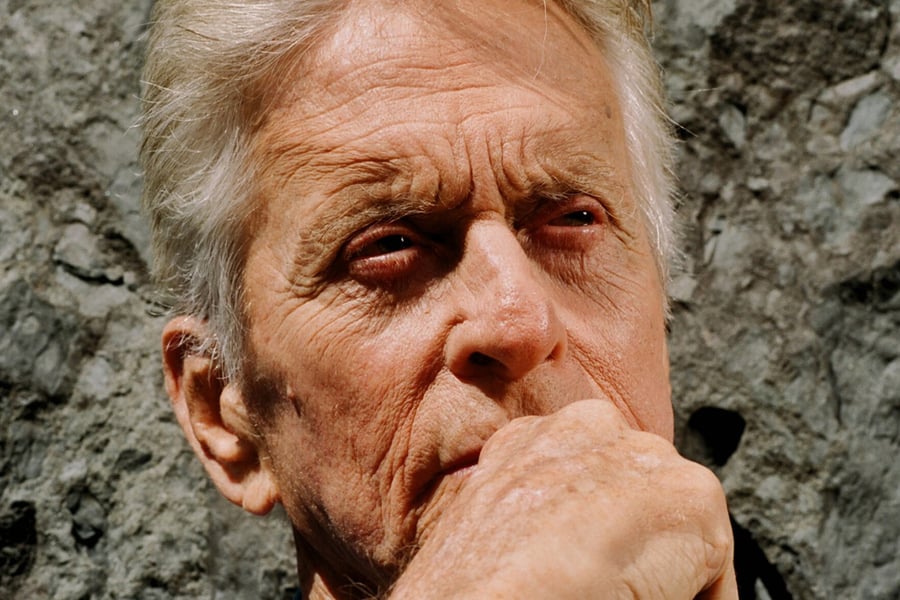
Michael Douglas, firmly in his smooth silver-fox era, has opened the door into secret compartments of his life. Douglas, 82, has just published an incredibly dishy, wildly entertaining, at times both hilarious and painful new memoir, One Helluva Ride. It’s a tale that spans generations of Hollywood royalty, from his father Kirk’s rise to stardom to his own run of classic films as both producer and actor: One Flew Over the Cuckoo’s Nest (1975), The China Syndrome (1979), Romancing the Stone (1984), Wall Street (1987), Fatal Attraction (1987), Basic Instinct (1992), and Falling Down (1993), to name some of the biggest. Written with Shane Salerno, the book is one of those rare memoirs that both entertains and sheds light on a lost world of Hollywood of glamour and decadence, with lots of sex and drugs and even some rock & roll.
To discuss all this, Douglas has invited me into his palatial apartment overlooking New York City’s Central Park, one of several homes he owns and enjoys. He’s a welcoming and gracious host, no servants or assistants bustling about. Just Douglas padding around in his socks, still as slim, handsome, and charming as ever. Douglas makes me a coffee, and we sit down in a living room with a view of his two Oscars, an Emmy, and other awards. Between Douglas and his wife Catherine Zeta-Jones, the trophy case is so large it fills up a corner of the massive living room.
At times when he’s looking back during our talk, Douglas’ eyes well up. He’s an emotional guy, especially when discussing his family. Still, Douglas is unflinching in the book about how physically abusive and terrifying his dad was to him and his brother. How the divorce of his parents (his mother was the actress Diana Dill) was traumatic. In some ways, he was an original latchkey kid — except his parents’ apartments were on other sides of the country, and worlds away from each other.
So much of the book is about that elemental relationship with his dad, and how escaping Kirk’s shadow was impossible given Douglas’ chosen career. Battles with addiction run throughout, too. They cost his father one of his sons, Michael’s half brother Eric who died of a drug overdose in 2004, and almost cost Michael his oldest son Cameron, whose heroin problem led him to spend seven years in a federal penitentiary. (Cameron Douglas wrote his own book, Long Way Home: A Memoir of Fame, Family, and Redemption, in 2019.) Michael is open about his own stint in rehab, his battle with cancer, and his many, many affairs.
But above all he’s here, as he’s always been, to entertain, and the book is a nonstop romp through more than 80 years of showbiz. It’s a look inside one of the great lives of the late 20th century. He’s still got a few feuds and scores to settle (Brian De Palma and Joe Eszterhas, look out) but also a lot of thanks to give. The man has lived so much, and he’s ready to tell us all about it.
What inspired you to write the book?
I said, “Well, Dad did a really great biography,” and he’d written other books. I had some time with the cancer to sort of take inventory and I said, “Fuck it, between my dad and I, we got 80 years in the business and 120 movies, and I really can’t think of anybody else quite…” I’m the first sort of super-nepo baby. It’s a real story of that legacy. And I realised memory and family is all you got left. So I began to enjoy being able to pick up information from the past, and said, “Let’s go.”
You were pretty candid about your dad and growing up. Was that hard to tap into?
The best part was knowing how it all turned out, which was a lot of love and tremendous respect. But I had to be honest about the abuse or just the fear factor that entered into going out to visit him, and understanding as you got older and then saw your own actions very similar to your father. [Douglas tears up.] Dad was overwhelmed and he was sort of caught between his father, who never gave him a pat on the back, ignored him. His father was an immigrant, didn’t speak English, Russian Jew, got over here in 1902.
Love Music?
Get your daily dose of everything happening in Australian/New Zealand music and globally.

He had seven kids. Dad had six sisters and his father was a rag man. So he said, “If I ever have kids, I’m going to be a father.” And lo and behold, he’s divorced from his wife. He’s got two kids. So when we go out to see him, he meant well, but he was so overwhelmed with work — those were the days when they were doing five movies a year.
It was so intense. There was a dynamism about him, a strength, a rage, and he didn’t know what to do. He wanted to be a good father, but also that was the generation of whacking. You whacked your kids. My mother had a hairbrush.
There’s also the tension in that marriage, too, of a first-generation Jewish immigrant marrying this high WASP. That’s a bit of a culture clash, no?
They were opposites attract. And my mother was 16 and she lied about her age entering the American Academy [of Dramatic Arts]. Dad was a Russian Ashkenazi Jew. And my mother was a Protestant, Church of England. Her father was the attorney general of Bermuda and all of that. [Points to his mantle.] That’s actually a Life magazine cover of my mom. She was a beautiful woman. This was when, after the academy, my dad had gone into the Navy. Mom’s cover came out and he told his friend, “I’m going to marry that woman.”
And he did.
Which he did, which was so weird because that’s exactly what I said to Catherine.
You really could have called this book “Fathers and Sons.” So much of it is about your relationship to your dad and then you and Cameron, too. You really feel it on the page. Especially with your own pain about being a dad.
It’s hard. It’s hard. And I made a lot of mistakes. I fought Shane about starting [the story] so early, but I realised so much was a result of the combination of [my mother and father]. She was a diplomat and gentle and tried to make everything right and good, which I can tend to lean that way. And then also my father with that intensity and rage. To me, the magic was when they got divorced, because I remember the fighting and the yelling and screaming, but the first time he came back to see us in this apartment up at 85th Street we were so nervous, and he came in and he kissed my mother, “Hello, hi.”
And I remember I just broke down crying because the tension was so much. I was blessed that the two of them mutually respected each other, got along. So I saw them both not making the kids take one side or the other. And then they went on and Dad married Anne [Buydens], who was a French woman who’d been a publicist on one of his pictures. And Mom married Bill Darrid. And I had these great stepparents. There was no friction. I had a wonderful middle-class upbringing with Mom and Bill, and Anne was lovely, too. And the four of them liked to have dinner together. So there was a comfort factor there.
Which was rare for that generation, though.
Very rare, even for this [one]. I kind of preach that, about “please don’t drag the kids into these things.”
Your book tells the sweep of the boomer generation. I mean, you guys accomplished so much, and some of it’s great, but then some of it’s pretty selfish and debauched.
I had to be honest about the alcohol and drug abuse for those years. It didn’t help anybody. But the Sixties, Seventies, Eighties, it’s just a whole different period.
Well, Rolling Stone isn’t Rolling Stone without all that stuff too, right? One Flew Over the Cuckoo’s Nest and Ken Kesey or Hunter Thompson, none of that stuff happens without the substances. So do you look back on it and say, “This was part of the culture and we were making the culture”?
Yeah. But for me, again, I was growing up on the East Coast going to private schools here in New York, all boys. I went to Choate, very proper prep school. And looking back, my first big decision was when I decided to go to college and I realised my ass was so tight. The best decision I made at the time was going to the University of California at Santa Barbara, I guess for all the wrong reasons — there were girls. That was when the UC system had really taken off. I went there in 1963 and was introduced to the hippie culture. I just thought it was magical. First off, it wasn’t monetary. Everybody was really based on a familiar sense and sharing and giving. It was a spiritual and just a lovely, magical life.
One of the things that struck me in the book is, and forgive me, I just thought Kirk Douglas’ kid, well, he’s going to be raised with privilege, but it really was middle class. They weren’t giving you that much, and you end up selling weed to pay for college.
Yeah. The whole “Hollywood royalty” as if dad came down from heaven. He was struggling. And my mom was on a soap opera, and a play. My stepfather was an actor, and he produced a couple of plays on Broadway. It was a theatrical and artistic culture. But entertainers make for good dinner companions.
For sure.
They have good stories. So I enjoyed, as a young kid, hanging out with them and their friends. Or when I was out with Dad and they’d have dinner parties and Don Rickles was there and Frank Sinatra and Cary Grant, Tony Curtis. And you just saw everybody with their own insecurities and foibles. You saw it as a job and what they had to do. So it took away a little of the imagination of what show business was like because you saw the hard work. I became a theatre major because I had to declare a major, but I had no interest per se. And then I started trying to act and I was really bad. I had terrible stage fright. I hated going on stage.
Did the drugs help you overcome that?
No. I don’t know. It was painful. I don’t know. I just wanted to get over it. I wanted to fight to get over my stage fright. I just hated standing in front of people. I was an introvert, kind of a shy kid growing up. I kept everything inside. I was wary of Dad and his [temper]. My brother Joel had a tougher time. His best friend was Billy Lancaster, Burt Lancaster’s son. They were talking one day and Billy said, “Joel, your father wants you to stand up to him. He wants you to be a man, right?” So Dad was upset one time and went at him and Joel said, “That’s not right, Dad.” He stood up. Dad looked at him and he smacked him across the room. I remember he was crying and called Billy back, “He hit me.”
It really doesn’t sound easy being his son.
I guess the most difficult part of being second generation [in Hollywood] is kids know or assume they know more about you. I don’t know who your father is or much about where you came from and this or that, but they, on [learning] one thing, Kirk Douglas’ son, said, “OK.” So then they make all these assumptions and some of them were mean and off. It took me a while to understand where that was coming from. Dad used to talk about it later in life. He said, “Michael, my story’s the classic rags to riches. It’s the whole big arc.” He said, “Yours, you don’t get that opportunity to really be able to explore or share.” It’s a much more narrow arc, but especially with the assumption that it’s a tremendous advantage. And it is and it isn’t. I remember when I first started acting, everyone would say, “You’re just like your dad, it’s amazing.” “Oh, look at that, just like your father.”
Before all your success, you had a string of failures. Your first movies are disasters. Five in a row. Did you think about quitting?
No. I didn’t put it in perspective. I had this one movie called Hail, Hero!, and the opening, it was being shown at Radio City Music Hall, which has got the Rockettes opening. I called a friend who’s in New York and he saw the picture, and I said, “What’d you think?” There’s this long pause. He said, “Michael, what can I say? There were more people onstage than there were in the theatre.”
I just was happy to have work, but then five turkeys in a row. I was doing off-Broadway work. I just slid into television. I played a bank robber on The F.B.I. I remember when I had a scene inside the bank, they were holding me, the car pulling up in the bank, and I came into the bank and I yelled, “This is a holdup!” Everybody, all the actors looked fucking frightened, man. I was feeling so good. But the director came in and said, “Let’s just set it up again.” I said, “It was good, right?” They said, “Yeah, but look at your fly.” My fly had been wide-open because I’d taken a pee right before the shot and I was nervous. All the people that were staring at me didn’t know whether I was a pervert or a bank robber.
You’ve been able to capture the zeitgeist multiple times: The China Syndrome, One Flew Over the Cuckoo’s Nest, Fatal Attraction, Basic Instinct. That doesn’t happen to a lot of people. Do you think you had an instinct for it or were you just lucky, or both?
The really fortunate thing starting in my career was my last two summers at UC Santa Barbara, and the first summer after that, I worked at a place called the Eugene O’Neill Memorial Theater in Waterford, Connecticut. And they had a national playwrights conference there. And it was a list of great writers. I mean, John Guare, Israel Horovitz, Lanford Wilson. And so you sit there on the sidelines and you’d listen to these conversations about purpose and motivation and changing structure. So I knew much more about structure than I ever thought. I realised at an early age just how important it was. And then, I’m a news junkie. I have always been politically involved. But saying that, I thought China Syndrome was a great horror movie. I just thought, oh, my God, a nuclear power plant is the monster.
We had this incredible moment when the Three Mile Island meltdown happened 12 days after the picture opened, and it was like an epiphany. I’m not a religious guy, but it was like I found religion. I thought God is telling me this is that. And so I’ve been pursuing actively, since the early Seventies, the elimination of nuclear weapons.
Gordon Gekko’s Wall Street line: “Greed is good.” I don’t think a lot of folks got the message of that movie.
Probably of all my movies, that’s the one I get more people from Wall Street coming up [to me about]. “You’re the man, you’re the reason I got involved in Wall Street.” I say, “Guys, I was the villain in that picture.” “No, no, no, no, no. You weren’t.”
Do you think if you and Oliver Stone could go back, you’d rewrite it so Gekko suffers more?
No. Well, I mean, that’s the devil. I don’t think we would’ve been better at making him more ugly. I mean, the devil is seductive. Evil isn’t so evil you would push it away. Evil is seductive. Evil creeps into you.
And you even based a little bit of it on Trump, right? I mean, Gekko is like that outer-borough striver in some ways.
Yeah, but not really. [Trump] played a small part in the sequel, Money Never Sleeps. We didn’t use the scene, but then he was playing himself in a barbershop scene. I never saw it coming. I met him. I played golf with him. He was at my birthday years and years ago and had a good self-deprecating sense of humour. He pontificated, but had the ability to laugh at himself. But I never saw this side coming. I think he was deeply helped by the Heritage Foundation and Project 2025.
The other part of the story of America today is a bit of another character you played, William Foster, in Falling Down. Foster, a defence contractor who’s just lost his job, rages at the burdens of everyday life in America, and thinks the world is working against certain people. I think that guy anticipates the angry Trump voter. Especially when he has this moment of realisation and says, “What, I’m the bad guy?”
Yeah. Right. Well, that was in post-Vietnam war and people forget that Southern California, besides the studios, is really the centre of the military-industrial complex of our country. And here’s a total patriot, who worked hard in his country making these weapons. And then they were so successful at it that he was fired and he has a bit of a breakdown. “How can I be… Why am I fired? I mean, I’ve done everything I should have.” I like that movie a lot, too.
Do you think, though, that it mimics some of the anger that’s out there today, or at least echoes it?
Oh, yeah. It’s more about how a guy can be converted to a MAGA type. That anger about “it’s unfair.” “Other people who are not white are taking my job.”
What did your son Cameron think of this memoir? I assume he’s read it.
He hasn’t read it. No. I’m still waiting for him. Catherine just got it a couple of days ago. I’m sure it’s rough for him, but Cameron wrote a book about his whole existence, which was tough. Look, drug addiction is a nightmare and your heart goes out. My heart went out to my son, but it also affects a lot of people around [the addict]. I was just sharing the severity of it and the number of years that it caused me and my wife at the time, Diandra, a lot of pain and a lot of exhaustion. Yes, you love your son, but you’re angry at a certain point. I’ve lost a brother, Eric, in a drug overdose, and I used to watch the pains that my father went through. [Tears up again.]
I remember Dad going to group meetings at 82, 83 years old, where you’re told all the things that you did wrong as a father 60 years ago. And I remember watching this and saying, “I’m sorry, I’m not going that way. I know I made some mistakes. I’m not going to take the full brunt.” It’s tough for people to understand.
I weathered this for 30 years with [Cameron]. Thirty years, calls in the middle of the night and this and that. It’s OK for you to be angry. You can still love your son. He’s your blood. He and I are close. I love him dearly. He’s brought me two beautiful little grandchildren and he’s doing well. He’s out on the West Coast.
What do you think he’ll think of the book?
Well, look, I mean, for all of them — all three [of my kids] are actors. Cameron’s an actor, Dylan, and Carys. They all are. And I know how hard it was for me early on, beginning, having the success that my father had. So now they have two generations looking at them. So I think he’ll be proud of me. I mean, he knows a lot of my own bad behaviour back then. But I feel for them.
I was surprised that you had a real chip on your shoulder about acting. You had something to prove.
Oh, there’s no doubt. I resented a lot of people who dismissed me early on. That was one thing. But then also, I was angry at the separation of television and film. When I was doing the television series The Streets of San Francisco with a lot of prestigious film directors and stuff, they treated you like shit. They really did not have much time for you. I’ve always felt that.
That reminds me of a great line in the book. Brian De Palma tried to have you fired from Fatal Attraction, before he was pushed off the project. A decade later, he apologises to you and you reply, “That means nothing. Zero.”
Yeah. Yeah. I have to admit that anger is a good false sense of energy sometimes that keeps you going. I’m fortunate in having so many people that I’ve been fond of and close friends with, but I have a short list of people that I look back on. Some of those first early movies I was lucky to get into because other people turned them down. Then finally for me was the year of Fatal Attraction and Wall Street, the two pictures being three months apart.
The Fatal Attraction stuff really jumped out at me. The studio wants to reshoot the ending and you’re trying to convince Glenn Close and she’s balking at it.
Absolutely.
And you go, “Babe, I’m a whore.” I just burst out laughing, but she wasn’t laughing.
No, she wasn’t. But I guess I was saying by that, I meant I went to see the cut of the film, and it was fucking great. It was great, except the ending didn’t work. Her character committing hari-kari, it didn’t work. This is what I was talking about where I learned earlier from all the years earlier at O’Neill Theater. It was a beautiful moment for her character. I said, “But Glenn, you were so good in this film. The audience wants somebody to kill you. It’s blue balls for you to take your life out of them. Your character wins. The audience is not happy.”
“So how are we serving our audience?”
Who are you serving, the artist or the audience? So I said, “Hey, I want to make the most successful movie possible. I’m a whore.” I mean, we’re all whores. I said, “It works for your character. It doesn’t work for the movie. What’s more important?”
But you must have been having these arguments about art and commerce your entire career.
Yeah. Well, especially because my pictures are not inherently commercial. I’m trying to make stories that do appeal to everybody. I mean, I’m kind of guilty about movies. They’re expensive, man. They’re expensive. And for just two hours of entertainment, well, OK. Yeah, that’s good. But I like to give a little food for thought. I love if you leave the theater and you’re a little haunted by the movie, then so much the better. It’s really affecting your psyche.
One of the revelations of the book is that you’ve been lying for 40 years about having an affair with Kathleen Turner.
Kathleen, yeah.
I mean, I understand, certainly, not telling your wife for all those years, but just a few years ago, you said, “Nah, never happened.” Why now?
We’ve always been good friends. I mean, not always. We went through a lawsuit, but she’s a good old broad. She’s a great gal. She had gotten married. We didn’t feel there was any reason to have her husband say “oh” or whatever. But when it came time to write the book, I knew in the spirit of making it an entertaining yarn, we needed a couple of surprises.
I asked her, she said, “Absolutely, Michael. No problem. I love you.” I love Kathleen. She’s a great, great gal. And those are memorable experiences that I will be eternally grateful for, because I really did not know any other actress who would’ve put up with the kind of situations — Romancing the Stone was such a tough production. It was the beginning of me getting to hate acting and pictures that I was producing and acting in.
In The American President, there’s a speech your character, President Andrew Shepherd, makes that I’m sure people throw at you: “We have serious problems and we need serious people.” I think that should be plastered over every billboard in America.
Aaron Sorkin is just such a great writer. I mean, the sad thing about that speech is it’s so appropriate for today, 35 years later. It’s like we haven’t moved on.
You said you weren’t religious, but does faith play a role in your life? Your dad found religion toward the end, and you’ve survived cancer and you’re looking at more years in the past than in the future.
After his helicopter crash [in 1991] — an 18-year-old student pilot died and Dad survived — he began to work formally on the Old Testament with a rabbi. Every week, he’d do a chapter in the Old Testament, and it played the crucial point where that was the beginning of his third act. Grandma said we got closer and closer because career was not as important anymore, certainly for him. And [he was] partially making amends, but partially finding a new purpose in life. [Douglas’ eyes well up again.]
I like the tribe. I consider myself a Jew because I believe in a lot. I guess one particular saying is an expression called tikkun olam, which means to make the world a better place, or to repair the world. I’m happy to accept that as my responsibility, to do it my own small way. That is my purpose in life.
From Rolling Stone US

