





























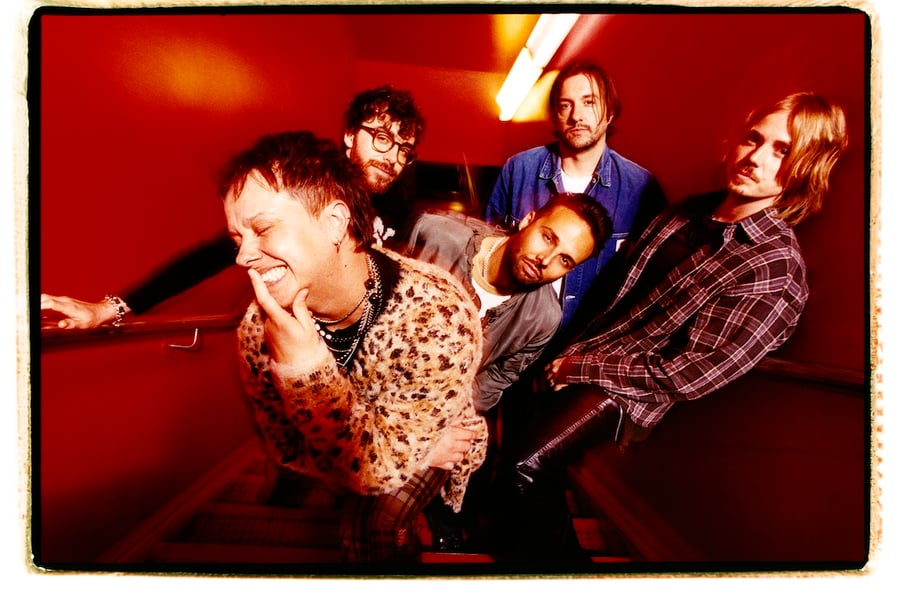
Conor Mason has a slightly different answer to the question of “what’s missing from your life?” Listen to a song called “If You Don’t Have Someone To Love”, and you might hear loneliness, or the ache of waiting for someone to choose you. The Nothing But Thieves frontman hears an invitation to look the other way.
“The greatest gift that you have in life is to love someone. It’s not to be loved,” he says. “I think everyone focuses so hard on, ‘Who will love me, love me?’ And it’s like your gift to the world is, ‘Can I love someone?’ If you don’t have that, if you don’t have someone to love, then what have you got?”
It’s a useful way into Stray Dogs, the Southend band’s fifth album. There’s longing in these songs, certainly. Mason acknowledges that much, before offering a fairly straightforward explanation: “That’s just the way I sing.”
But he’s thinking about what they have.
After a decade of records and touring, Nothing But Thieves have built a community that extends from the five people in the band to their crew, families and fans. Stray Dogs is their record for that extended household, and an attempt to capture the thing that happens when everyone gets together in a room. The rooms are getting considerably bigger. Their previous album, 2023’s Dead Club City, became their first UK number one, and its tour included two sold-out nights at Wembley Arena. The next headline run includes London’s O2 and Manchester’s Co-op Live. Mason is grateful for all of it. He’s also conscious that being able to fit more people into a venue doesn’t necessarily make them feel closer.
Recently, the band have been going small again: a secret Newcastle gig billed as “stray dogs”, intimate shows in Utrecht, Brussels and London within 24 hours and a sold-out run of stripped-back performances. For Mason, these have been a reminder of what he wants to take into the next two years on tour.
“It was such a lovely reminder of that connection I can feel with the crowd. And we all feel the crowd, not just me at the front,” he says. “Being able to see people’s faces, pick up on things, riff on things, have that real intimate sort of connection with the songs, that symbiotic thing that you can lose when you get big at playing arenas.”
Love Music?
Get your daily dose of everything happening in Australian/New Zealand music and globally.

He’s careful about how he frames the problem. They’ve worked hard to get here, and he’s proud of the position they’re in. Still, he’s seen bands reach arena size and watched the experience become “disconnected and cold.”
“Ultimately, we want people to see the show, so we can’t do 50 club shows,” he says. “So it’s like you get to that arena size and I’m really, really grateful of it. So I just want to make that world carry over into arenas and just figuring it out. And I think a lot of these club shows has been research and it’s been reconnecting to that scene.”
Stray Dogs approaches the same task from the studio. Its 12 tracks run like a night at a Nothing But Thieves show, with transitions and spoken passages keeping the listener inside the experience. To work out how to do that, the band spent hours watching themselves.
“We’d watch hours of footage and think about how we’d end songs or what sort of noisy chaos we’d do in between songs or how I would speak to the crowd,” Mason says.The bits that might seem incidental at a gig became part of the record’s construction — the ending that stretches out, the noise that links one song to another, the voice keeping everyone company between them. They were learning from a version of themselves that already knew how to hold a room.
“We like blending the worlds of something on wax and then something that’s live,” he says. “We wanted to make something where culturally it’s almost the opposite of what everyone likes to do, which is, ‘Let’s do the quickest hook in the first five seconds and then draw them in and then skip to the next song.’ This was like we wanted a long-form body of work that you have to really immerse yourself in from the start to the end.”
When we speak, the release is only hours away. Mason has been sitting with the record for about a year, waiting to see whether people like it. Making it brought the band back to Angelic Studios, where they recorded their debut, although the familiarity largely ended at the surroundings.
“When we first went there, we were so young and just had no idea what we were doing really,” he says. “We’d written a bunch of songs, but we had no idea about engineering or producing and world-building. And if anything, we weren’t taking everything all too seriously because we just didn’t know what would happen. You’re just having fun in the moment, which was great. That was a lovely juvenile experience.”
This time, they were steering the ship. Dom Craik produced the entire album, a first for the band, with Mark Rankin engineering. Returning gave Mason a chance to appreciate the distance between those two experiences. It also depended on knowing how to disagree.
“I think it’s really healthy to have friction and rub and different opinions. Otherwise, it would all just sound like one person’s vision,” he says. “I think the magic comes when we have slight rub and friction and differences of opinion, but we have a really healthy workplace of open communication. So anyone who has an opinion, we voice it out, we talk it through and we give it a go.”
By the time they arrived, much of that work was done. Mason estimates they spent eight months demoing, with demos often reaching 80 or 90 per cent of the final sound. Five or six months working continuously in their East London studio allowed them to get lost in details, sometimes buried beneath so many layers they scarcely registered on the finished record.
There was a drawback. “You can get snow blind because you haven’t had enough time away,” Mason says. Touring at least provides a plane journey, separate listening time and the chance to hear something differently. In the studio every day, momentum can outrun perspective.
On “I Needed You Then, I Need You Now”, the solution was to pull back. Mason had brought in a folky melody, but the track built around it wasn’t doing enough for the song. With so much intensity elsewhere on the album, they returned to its original shape.
“Let’s just get rid of the track and just have it as empty and intimate as possible,” he recalls. “And it gave breath to the album and gave its own place.”
“#5” posed another question: should they leave a simple song alone, or “Nothing But Thieves it” through production? Its bones won.
“The chords, the melody, the lyric felt like it wanted to just be as it was, super classic, super simple,” he says. “There’s no thrills, there’s no tricks here. This is a classic, almost like a Tom Petty style song.”
For all the work that went into shaping the record, this song needed them to trust what was already there. Mason also hears a little joke in its reflection on how far they’ve come. “How did it take five albums to realise the gratitude and the place that you’re at basically?” he says.
Knowing when to leave something alone is part of the confidence they’ve developed. So is recognising that a familiar writing style doesn’t have to mean making the same record again. Asked how they tell instinct from habit, Mason locates the answer in their shared appetite for change. He accepts that writers develop a recognisable musical language over time. Five albums in, he can hear their own across the melodies, lyrics and harmonies. That gives them something to build on, rather than a formula to reproduce.
“If we’re falling back on our instincts, at least our instincts are trying to shape it somewhere we’ve never explored,” he says. “We don’t go, ‘Oh, let’s write another “Amsterdam” or another
“Sorry”.’ We’re always constantly pushing the needle. So I trust that. I trust that process massively.”
The next challenge is bringing that openness onstage. Mason enjoys a polished, theatrical show, but wants to leave room for the audience to affect what happens. He describes himself as something like a telegraph pole, receiving their energy and sending it back.
“It feels like if someone’s off, if I’m off or if the crowd’s off, it doesn’t roll as much as I can try to get it going or they can try and get me going,” he says. “It’s got to have that connection.”
Australian audiences may get their turn late next year. Nothing is announced, but Mason says the band are working on dates for the end of 2027. Their January visit left him enthusiastic about returning, Australian summer included.
“If I had my way, I would be in Australia every week,” he says. “It’s very, very much up there in my favourite places at all, if not my favourite.”
Wherever they’re playing, he wants a show with enough space for something unexpected to happen. A face he can pick out. An exchange he can follow. Something that belongs to the people who were there that night.
We want to build more moments where things could go awry or we’re doing something more off the cuff or I have a moment with the crowd,” he says.
Stray Dogs is out now via RCA/Sony Music.

