






























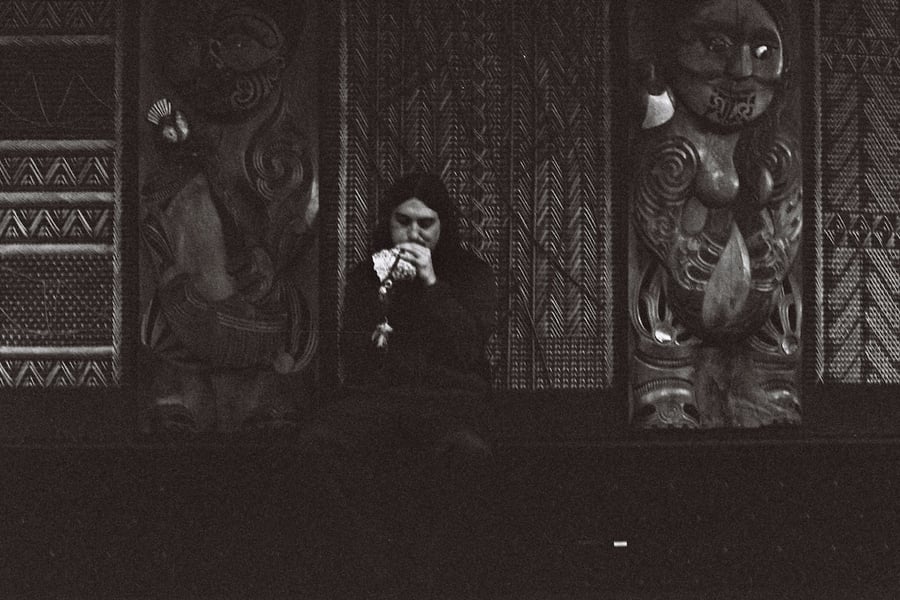
Two years ago, Payton Taplin (Te Rarawa, Ngāti Kahungunu ki Wairarapa) took a creative leap of faith.
Departing from the creative alias FABLE in favour of a new moniker, Greatsouth: a name change that was accompanied by a new sonic direction. Trading in the winning formula of FABLE’s alternative hip-hop for the Polynesian post-punk/indigenous indie rock sound of the Greatsouth project. His self-titled EP released in 2024 served as a bridge between the two identities and their respective sounds, with half the tracks sitting in the sonic world of FABLE and the other half embracing the Greatsouth sound. Last month, the artist released his debut album, Hellhole of the Pacific, marking a new era in his practice, presenting the world with the most realised version of the Greatsouth vision.
The common denominator between FABLE and Greatsouth is a commitment to centring kaupapa Māori. It’s an inherently Māori thing to tie one’s identity to location, and for Greatsouth, the name change not only represented a new direction but an acknowledgement of the past. “People always go, yeah, that’s Great South Road, but for me I’m thinking about who’s travelled this road; it’s whakapapa and my place in that history. It was a road essentially made for conquest, to invade the Waikato, and now, all these years later, so many of our whānau and whanaunga through the Pacific and other diverse communities have their livelihoods tied to that road.”
For Taplin, a preoccupation with history has been a constant source of inspiration. “I didn’t even want to make music. Initially I wanted to write novels, and I loved research and reading. Especially the history of Aotearoa; all my favourite writers are based in the history of place.” The record is steeped in that reverence for the past, the most obvious reference being the album’s title, an allusion to the pejorative used to describe New Zealand’s first Capital. “So many people have hit me up asking about the title, because it is so intense. It’s quite a visceral and heavy phrase, but it’s a historical phrase from the 1830s. People try to gloss over that history, but I wanted it to be confronting. I wanted people to think about and question what it means to be a Kiwi.”
Time is central to the album. It’s present from the opening track, which features a candid conversation between Taplin and longtime collaborator and friend Silas Futura (Ngāti Kahungunu ki Te Wairoa, Rongowhakaata). The conversation was accidentally captured after a field mic was left on. “We had just finished a whole day of field recordings, playing some taonga puoro at ‘Pukekiwiriki Paa’. All these manu started flying around us, and it just felt like such a positive tohu that we were on the right path. We just sat there for an hour buzzing out about it before we realised we’d left the mic on.”
View this post on InstagramLove Music?
Get your daily dose of everything happening in Australian/New Zealand music and globally.

Futura’s observation of transcending time speaks to the heart of the record, and no song exemplifies that better than the album’s title track, anchored around the perspective of a 28th Māori Battalion soldier. “The waitata is written from the perspective of a Māori Battalion soldier, who is just home from war. As he walks through the ngahere, he sees the world changing around him and without him. All this infrastructure is popping up around him, but it doesn’t leave a place for him. He’s served and fought for a country that he doesn’t have a place in.” Taplin explained that the waiata served as the catalyst for the album, providing a clear purpose for the rest of the songs that would follow. “I’m really trying to create a discourse about our history and its effects, about what it means to be a ‘kiwi’. If that’s the only thing that happens as a result of my waiata, then it’s served its purpose.”
As Taplin explained, the major inspiration for the album’s recontextualising of the past to understand the present came from Witi Ihimaera and Whiti Hereaka’s collection of short stories, ‘Pūrākau: Māori Myths Retold by Māori Writers’. “I think it was a short story that Whiti wrote. Perspective of Papatūānuku, but in the story, she’s a single mother growing up in Tāmaki, trying to raise her children. There’s this power to this traditional story, of such importance, bringing that into the now. It really stuck with me.” Taplin cites that story as a direct influence for track four, ‘Held my own’: “‘Held My Own’ is that, pretty much. It’s a longing song for Papatūānuku, but from the perspective of today. I wish we held out longer so that we could hold my own piece of her, my own plot of whenua, my own whare.”
There are references to particular plots of whenua throughout the album. Landmarks are not only acknowledged by name but incorporated into sonic elements. Taplin was intentional with this in the recording process: “With all the waiata in the album. If it’s tied to a landmark, we went out and collected field recordings from those places. All the songs contain sounds from those places. I wanted to mihi to the places that look after us and nurture us, making sure their voices are incorporated into the waiata. For ‘It’s getting hotti’ that meant singing to the harbour, the song about the harbour, capturing field recordings of the harbour to put back into the song about the harbour.”
Alongside field recording, it was important to Taplin not only to include taonga puoro in the waiata but to make them the central feature of the compositions, something he credits to his relationship with the Tāmaki Oro Rau collective. “Taonga puoro has been a gateway for me to think differently about how I compose and make music.” It goes beyond just using taonga puoro; it’s about picking the right one for each song. On ‘Held My Own’ you can hear the percussive sounds of the Tumutumu Kōhatu, a taonga that has a direct relationship to the song’s subject, Papatūānuku. “The Mātauranga around Tumutumu Kōhatu is that they are the bones of Papatūānuku and that paired with the lyrics of longing for the return of whenua just felt right.”
It’s the threading of these musical traditions that makes Greatsouth’s particular brand of alt-rock so strong, something that Taplin explains has always been a feature of his practice. “With my music, I’m always trying to experiment, push the waka out, and fuse sounds that usually don’t go together. Lean into our ways of being, our stories of where we are from, and fuse them with elements they don’t usually get paired with.” It’s within the genre of King Krule-influenced indie rock that he found a vessel to hold his anger and concern at the devastating effects of neoliberalism. You can feel it in the delivery of his vocals on the penultimate track ‘Not one more acre ’, which derives its title from the rallying cry of Dame Whina Cooper. “The phrase of Dame Whina Cooper was the catalyst. But, on the other hand, I also wanted to take the piss out of that phrase you hear all the time: ‘work hard, and you can buy a house’. People who have benefited from the lottery of time will turn around and tell us that we aren’t working hard enough. It hurts more when you are told that on your own whenua. Honestly, when I wrote that song I just needed something I could yell.” That political sentiment of ‘Not One More Acre’ isn’t new, and in pairing it with a contemporary musical form like indie rock, Greatsouth recontextualises that message for a new generation. Providing the soundtrack to the next generation’s struggle for Te Tiriti justice.
There has never been a more fruitful time for blending contemporary genres with kaupapa Māori, and Greatsouth’s music is an important part of that zeitgeist, something that the artist doesn’t take for granted. “Seeing the Silver Scrolls finalist was crazy, all the homies in the mix. Geneva’s in there, MOKOTRON too. The mahi that MĀ is doing as well, and so many others. For me, I want to help carve out a space for Māori in the alternative rock, indie scene. But at the end of the day, I’m just happy to be a part of the canon of Māori music. If in 50 years I can be to someone what Herbs is to me, then I’ll be happy.”
The brilliance of Hellhole of the Pacific lies in its commitment to specificity. Being intentional with the use of taonga puoro, travelling to specific places for field recordings. As Taplin explained, his waiata are a vessel that make a specific experience feel universal “For my waiata as an urban Māori from Papakura, it’s a specific thing. I want more of that specific perspective. I think that’s the phase of artistry we’re in. We’ve gone from a space of barely any reo except for traditional kapa haka, to fully reo Māori waiata in contemporary genres. I just want to contribute to that. I hope some Māori kid hears the record and goes, ‘damn, I can make music about my perspective; it’s more than worthy of being told’. Show up how you want to show up, and tell the stories you want to tell.”

