






























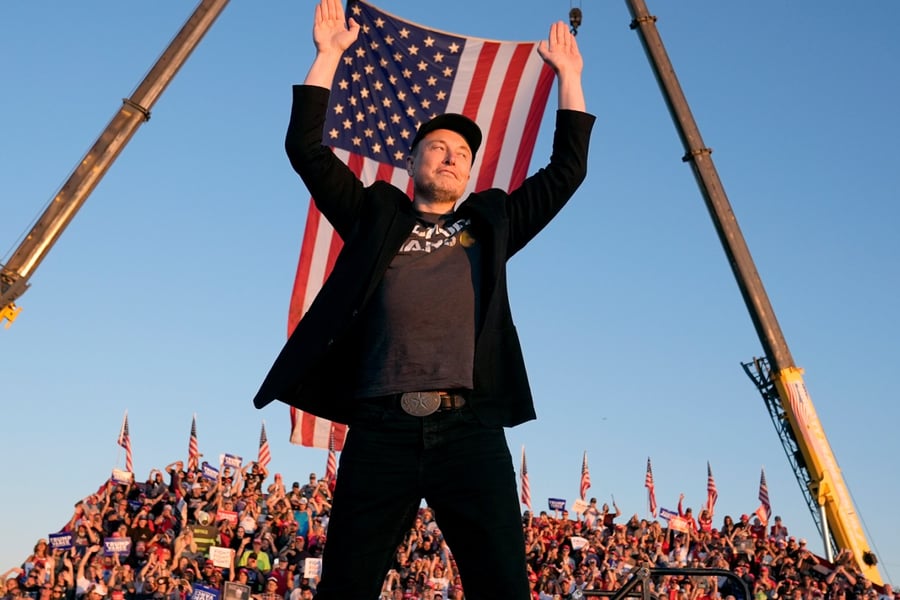
In the beginning, Elon Musk preferred to be known as an engineer. Not a CEO, not a tech-industry titan, not a future trillionaire or free-floating agent of chaos who seemed to be engaging in Bond villain cosplay. His business cards identified him as an engineer, and he was, according to one of his employees, a damn good one, “but not an educated engineer.” He even insisted on wearing T-shirts and jeans to work after he’d become rich and famous so he’d look the part. Yes, Musk was part of that wave of Silicon Valley pioneers who liked to move fast and break stuff, using the momentum of the internet’s Wild West era to springboard into the 21st century and maybe make a few 10-figure deals along the way. But he wanted to be thought of as a builder, someone who could bring dreams of a better world to life.
Eventually, Musk began comparing himself to a real-life Tony Stark — part playboy with the power-chord intros, part savant innovator, part superhero. Other depictions would follow, courtesy of admirers, lovers, critics, C-suite executives, and occasionally his own over-nourished ego: genius, grifter, disruptor, the embodiment of capitalism, pathological liar, plutocrat, broligarch, “Dark MAGA.”
There’s one description in Musk, Alex Gibney‘s epic documentary on this man who now looms way too large in everyone’s life, that may halt you in your tracks. (The film premiered at the Venice Film Festival Sept. 8 and is set to play at the Toronto Film Festival next week before opening in theatres Oct. 16.) “Elon is a nuke,” says Ashley St. Clair, a right-wing influencer who entered Musk’s orbit and eventually gave birth to one of his children. You might be tempted to label it pull-quote hyperbole had the Oscar-winning documentarian put this particular testimonial near the beginning of his two-part, four-hour movie.
The declaration comes near the end, however, and by that time, there’s more than enough evidence from the prosecution to suggest St. Clair’s sentiment should be taken very, very seriously. It’s not just that Musk has amassed a staggering amount of money, power, and influence. By this point, he seems to be all in on using these things to push an agenda that goes beyond self-preservation and enrichment, and now flirts with annihilation. Most portraits simply give you a sketch of the subject. This one gives you existential chills. It’s designed to scare the living shit out of you.
Musk deemed the project a “hit job” when it was first announced back in 2023, calling Gibney “a douchebag” on Twitter shortly after he’d purchased the social-media platform, renamed it X, and remade it in his warped image. (The filmmaker’s response: “Douché.”) Gibney has said that he’d never set out to do a hit job. He had also not originally planned on making such an extended, exhaustive look at the man behind Tesla, SpaceX, Starlink, and various other tech endeavours, until Musk began dabbling in politics and listing “the 2024 election” as one of his accomplishments. There’s a world in which Musk ends at the halfway mark, and merely traces the South African immigrant’s ascent from pimply, shambling startup owner to electric-vehicle entrepreneur, avowed space explorer, and the kind of tech celebrity who got to host SNL. We’ve witnessed how Musk has used his wealth, imagination, and ability to push the best and brightest around him to engineer genuine breakthroughs. And we’ve watched as he’s sold Silicon Valley snake oil and played around with the truth in terms of, say, how you can change out a Tesla electric battery quicker than gas up a regular car, or the foolproof nature of the EV’s autopilot function.
Indeed, in those first two hours, Gibney offers ample proof that Musk is not the 21st century’s Thomas Edison so much as the latest incarnation of P.T. Barnum, as well as someone who has some… interesting ideas about interpersonal relationships. Both Justine Wilson Musk, the tech titan’s first ex-wife, and St. Clair talk at length about his ability to turn feelings of intimacy off and on like a faucet, as well as his obsession with siring a “legion” of children and offering unsolicited donations of his seed; one person testifies that it was a like “a Gatling gun of sperm in his DMs,” a phrase which, once heard, regrettably can never be unheard. Musk’s own father gets screen time, as do third-party anecdotes about the legacy of damage that this paterfamilias passed on to Elon. Musk himself shows up as an AI avatar — purposeful irony alert! — who mouths Musk’s own statements. It’s somehow both an effective way of skirting around the subject’s lack of participation and a distraction. Ditto some of Gibney’s other, bolder aesthetic choices, like framing numerous incidents through a first-person shooter, to emphasise Musk’s obsessions with gaming and simulation theories. The documentarian’s signature narration style is also, in effect, an attempt to fashion his own hardboiled investigative-journalist voice that will once again be a dealbreaker for some folks. (Lotta great voiceover artists out there.)
But then we get to Trump, and X, and the Orwellian-sounding Department of Government Efficiency, and how Musk begins to insert himself directly into the political narrative in a way that doesn’t involve putting fingers on the scales so much as setting the scales themselves aflame. You understand why this had to be a four-hour movie, and why the second half plays like equal parts dystopian sci-fi and outright horror flick. Once a major proponent of regulating artificial intelligence and understanding its threat to humanity, Musk seems have majorly reversed course — cue Grok and MechaHitler. The whole “protect free speech” concept that supposedly justified him taking over Twitter quickly turned out to be hot air once the platform devolved into a sinkhole of hate speech and an algorithmic world in which Musk was the main character all the time. His ability to fund campaigns for far-right and/or blatantly authoritarian political parties has gone from financially motivated to straight-up sinister. The longer the film delves into his DOGE reign of terror, the more the question of why — and how, exactly, all that seized data his team procured is going to be used eventually — gives you a sense of free fall.
Love Music?
Get your daily dose of everything happening in Australian/New Zealand music and globally.

Musk now views unlimited power as his natural possession. Musk‘s power comes from the cumulative way that it gathers so much of what we already know about Musk and how he’s warped modern society, and presents it less as isolated incidents, scams, frauds, bad-faith arguments, and god complexes than the portrait of a sociopath behind the wheel. You could call it a cautionary tale, except for the fact that it believes, as WIRED editor-in-chief Katie Drummond explicitly notes, it all feels too late now. Gibney said in a press conference that he doesn’t believe the story is over and the game is lost. Yet it’s hard not to walk out of his magnum opus and not feel a deep sense of despair. We may not know exactly how we got here, but we’re here. It’s a nonfiction horror movie.
From Rolling Stone US

