






























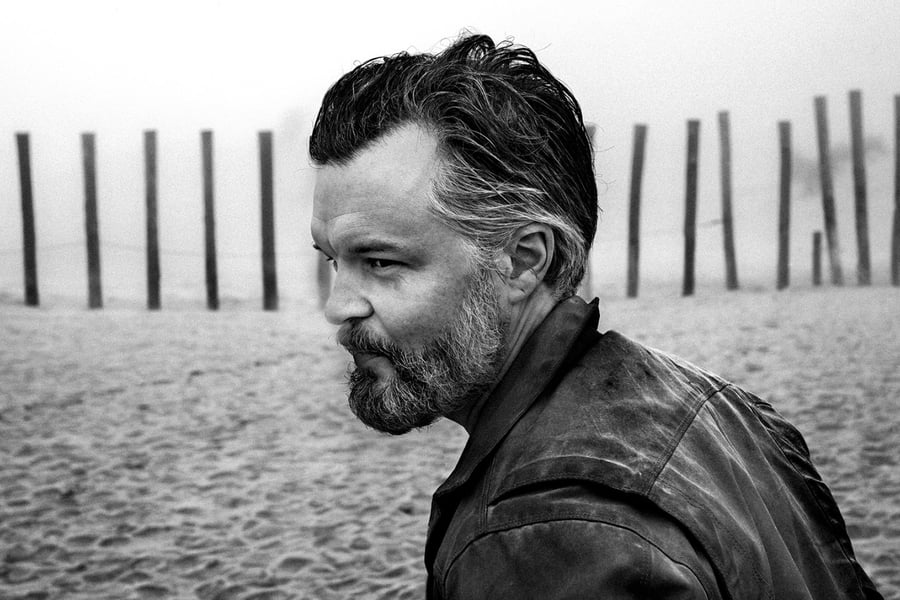
Kristian Matsson, otherwise known as the Tallest Man on Earth, was up at 5 a.m. to play the fiddle. He spent the rest of the morning getting his hands dirty: foraging for mushrooms, doing chores around his property, surveying progress at the concert hall he’s renovating 10 minutes away, where he’s functioning right now as both owner and janitor. “I’ve been a caricature of myself today,” says Matsson, calling on Zoom in a red flannel while light pours in through the window behind him.
A lot of his days are just like this. Fixing things and writing songs, touring around on his ATV, tending to the horses. It might all sound like a scene from the Appalachian hollers where Matsson once turned to for sonic inspiration, but he’s actually in Sweden: in the county of Dalarna, where he was born. This is his full-time home now, after years of living in Brooklyn and almost two decades and seven albums of chasing American sonic traditions. More often than not, he’s just a guy on his lawnmower here, checking out the horizon.
“I get older and more cynical and all that, but I search for the moments you get to be in awe of how cool a tree is,” Matsson says with a laugh, aware of how that sentence might make him sound like he was foraging for something a little more hallucinogenic than savoury. “I’m not on mushrooms, I promise,” he assures me. “Just food mushrooms.”
Matsson’s settling in here is more than just a matter of place. Since childhood, he’s run away from the Swedish folk traditions that defined his country and his youth: the fiddles, the flutes, the embroidered costumes, the polska dances. That kind of stuff was for tourists who wanted to duck in and out for the Midsommer celebrations in cheap flower crowns, the music itself too soft and “rounded in the edges,” Matsson says. “Of course, I started listening to punk rock instead and wanted to be Iggy Pop. I just didn’t want to be a fiddler in a weird costume.” He discovered Bob Dylan and Delta blues, which were much more exciting than what was happening just outside his window.
Matsson’s new album, Just Beyond Endless Mountain, finds him no longer running from those traditions, embracing the sounds of his Swedish heritage in these urgent, emotionally captivating folk songs. He no longer shuns the flute or the fiddle, and he realised that none of these traditions are really all that different when you break things down to the basics. “I’ve been learning a lot of Skip James songs, and the tonality is very comparable to some of the field recordings over here,” he says. “How you treat a minor key or major key. It’s even the same words, but in Swedish, as an old ballad from England or banjo music or the blues.”
It all happened a little bit by accident. Matsson came home to the farm he’s owned in Dalarna during Covid, and he wasn’t planning on staying permanently. But when restrictions were lifted and he hit the road again on tour, the pull to stay in America just wasn’t as strong as it had always been. A serious relationship ended, and, most importantly, his father had been diagnosed with Alzheimer’s, which found Matsson wanting to connect much more closely with the land and the culture that raised him. It also made the stark differences in healthcare between the two countries seem eminently apparent.
“Even though I am a 43-year-old white dude and the world is created for me, at least there’s something psychological about knowing there’s a safety net here,” Matsson says about living in Sweden. “It’s not as aggressively capitalist as it is over in America, which for me can really hollow out the daydreaming. I’m not pointing fingers at just America; we’re messed up here too. We’re all responsible for this planet. But there are a lot of things going on, and it’s a little draining for the optimist in you.”
Love Music?
Get your daily dose of everything happening in Australian/New Zealand music and globally.

Matsson grew up with America, and American music, as the holy grail — the folk and blues icons like Dylan and James, the punk bands, the counterculture. He still loves it all, but he found himself becoming “curious about what he had taken for granted” back in Sweden. Curious not about what a life would look like (or what his music would sound like) if he returned to where he came from, but if he crafted a new future where he could embrace latent sides of himself and his own history, and make them a natural part of his creative story.
When Matsson’s father died in 2024, that curiosity only grew. Anyone who has lost a loved one to Alzheimer’s or dementia knows that, even before they’re physically gone, it’s a long, excruciating process of loss. “I had this feeling that I hadn’t said goodbye,” he says. “That I hadn’t asked him all the questions.” Part of finding those answers meant going back to his father’s roots, and his own. The music that existed just outside his window and peppered his childhood. Picking up the fiddle, an instrument that “bit me every time I picked it up,” diving into field recordings of Swedish folk music. He found not just nostalgia, but joy.
“It was the same thing, and the same curiosity and awe, as when I was digging into Appalachian music or Delta blues,” Matsson says.
The first songs he started to write about his father were understandably sad. He didn’t think that’s what his dad, who was his “biggest fan,” would have wanted. “My dad was a very happy, social person,” Matsson says. “He laughed at his own jokes, but it was charming and he could talk to anyone. He was just a beautiful spirit, and he wouldn’t like for me to be moping this whole album through. So I threw away those lyrics and rewrote a lot. I cut off some branches here and there, and ended up with loving songs.”
Just Beyond Endless Mountain feels loving, pastoral, and raw, with long fiddle solos, flute that dances around the lyrics and scores of other orchestral instruments, most that Matsson plays himself. Sometimes, they feel dreamlike; others, like field recordings of his life as he tries to find the light (“even in these shit times, I still love you,” he sings on “Times”). The delightfully tender “Overboda” was written for a friend’s wedding: he started out on the fiddle, but then set it to guitar so he could play it while crying (“thank God, because I was just bawling,” he remembers of the ceremony). Though born out of disarray and deep grief, the songs carry a contentment that can only come by finding a way to fuse who we were with who we are and making peace with the past.
He also thinks about the one cultural frontier he hasn’t crossed yet: making albums in his native language. He’s been writing here and there in Swedish, but it’s “super scary and extremely naked,” Matsson says. That would probably be a side project, because he likes touring in America too much. The fiddles, however, are here to stay. He opens his show with one now, a traditional polska, even though he doesn’t consider himself anywhere near an expert at the instrument.
But being imperfect, and learning, is part of the point. Matsson fights with his phone for attention like anyone else, “with apps to shut off my apps” to help resist the urge to doomscroll when boredom comes around. Building his concert hall, where he hopes to host all sorts of music, dance, and theatre productions, is his own sort of counter-narrative to a world where AI looms. He was watching an interview with someone from AI company Suno recently, and it pissed him off to no end.
“He was sitting there talking, saying, ‘Musicians used to have to do this dreadful work of finishing songs and struggling with them,’” Matsson says. “’And now, we’re taking away that struggle.’ And just, you have no idea, tech bro. You’ve missed the whole point of art and creating.”
Matsson, like Just Beyond Endless Mountain, is hopeful without being naive. He looks to his community, to his culture, to the youth as his radar. He noticed that more bands are popping up lately — kids playing distorted guitars and turning the amps up loud.
“To see an emo kid, I get teary-eyed,” Matsson says. “I think nature is just trying to heal itself.”
From Rolling Stone US

