




























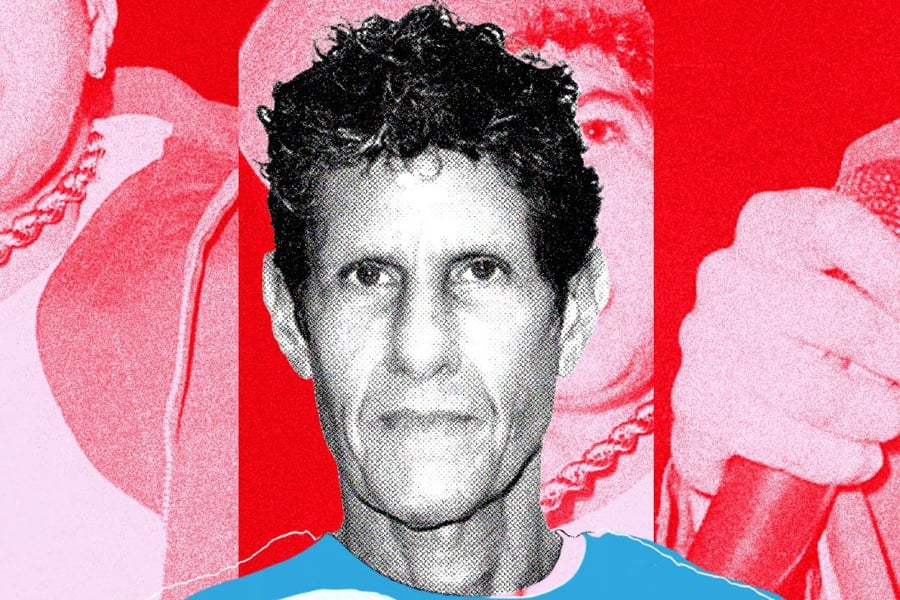
When Michael “Mike D” Diamond started working on his first solo album, Thank You, out Aug. 28, he did so without the pressure of carrying on the Beastie Boys‘ legacy. At least for a while.
Eventually, the gravity of the situation dawned on him, and he had to make peace with the responsibility he was now shouldering alone. “There was all the insecurity and fear that I think innately comes when you’re putting something creative out there, and ultimately, you’re sharing it with the world,” the musician, dressed in an oversized white T, says over Zoom from London.
With the Beastie Boys, he’d helped pioneer an eclectic approach to rock and hip-hop fusion. He and his bandmates Adam “Ad-Rock” Horovitz and Adam “MCA” Yauch, the latter of whom died of cancer in 2012 signalling the end of the group, would push each other to uncover new sounds, whether collaging samples on Paul’s Boutique or turning punk on its head with “Sabotage.” That spirit pulses through Thank You.
Mike D, now 60, wound up making an album with a group of young musicians that includes his sons, Skyler and Davis Diamond, billed as Mike D 5D. They packed Thank You with dubby, hard-hitting psychedelia that recalls some of the Beasties’ rock adventures, paired with his instantly recognisable rapping on standouts like, “What We Got,” the avant-garde “That’s Right,” and “It’s Time.”
“I had almost the opposite of writer’s block,” Diamond says, as he reflects on all he’s been through to get to this point for Rolling Stone’s Last Word column. “I didn’t have the pressure of, ‘I’ve got to make a record.’ Once I was in it, I had every form of total immersion and joy in the creative process, just collaborating with people and not looking up for many hours and then all of a sudden realising, ‘Oh, wow. We started a song here and it’s great.’ That’s my favourite part of making a record.”
When did you know the time was right to make music again?
I didn’t.
So how did you get here?
I don’t think I know. For me, once we were really in it, there was a point where I realised, “There’s something a bit different with me in doing what we’re doing.” So I felt like, “OK, I guess for right now, I need to be doing this.” I didn’t know that until I felt that.
Love Music?
Get your daily dose of everything happening in Australian/New Zealand music and globally.

The Beastie Boys broke up when Adam Yauch died in 2012. What did you have to work through to make an album without him or Adam Horovitz?
I needed the time for the grieving process. With Yauch, there was so much intertwined about him being an older-brother figure to me, to what he represented to us being in this band together. I had to go through all that. And then I also got the luxury of taking time to experience being a dad.
What’s the secret to getting into a solo album mentality?
At first, I was like, “Everything has to be new and different.” Once we got into making it, I could relax into, “There’s certain things that are inescapably me and that’s all right.” Ultimately, I had to think about, “What am I saying?” That came down to me having to be more of a leader. That was a new thing for me.
It’s funny, I’m so hesitant to say, “Oh, I’m a leader.” Maybe part of that is for me to work out with my therapist, and part of that is I think the word leader is so polluted right now, because the world we live in is dominated by the worst, most selfish examples of leadership.
Who do you look to as leaders now?
Younger groups. There are DIY laptop-core groups like Ear and Bass Spectrum that I really like. It’s exciting to me that people that are pushing their laptops to make beautiful noise that music software is actually created to [help] make.
You grew up in Manhattan. What’s the most “New York” thing about you now?
Oh, God. That’s a long list. I’ll tell you about New York things that I’m working on changing about myself. One is interrupting people. All of us as a family, we would talk over each other and interrupt each other constantly. We would do a lot more talking than we would do listening. I think it was a cultural thing. It really felt like there wasn’t enough time to shut up and listen. I remember bringing girlfriends who weren’t from New York home and they would be like, “Wow. You guys are all talking at the same time.” I’m like, “Yeah. So?”
What other New York things are you trying to change about yourself?
This general feeling of restlessness, impatience. Growing up in New York, everything you do, you want to be able to do it quicker, whether it’s getting your cup of coffee to feeling happier when the subway gets you from point A to point B faster.
How do you relax now?
When I was making this album, every break I took I would spend time silently at a Buddhist centre doing this practice that I was really grateful to have, because I feel like that’s where I got to have the space for an openness for ideas. And then the other thing that was totally new to me was being out in nature and spending time with my girlfriend hiking and camping. My only regret is that I didn’t start doing it sooner. In our world, where we have digital access to everything all the time, to be able to just unplug from that completely and actually profoundly experience what exists for us in that natural world is more crucial than ever.
Were you able to get out of your head when making the album?
In the beginning, I was just like, “I’m in such a free place. I don’t care what people think.” And then I was committed to releasing it, and I realised, “Fuck. I really do care what people think.” And I was devastated by it. All of a sudden you realise that you’re not impervious to all the opinions that the world’s going to have about you, that you’re too old, you’re too slow, whatever you have to say doesn’t mean anything anymore.
How do you live with that anxiety?
You just have to accept that’s part of the mix. I think it’s a privilege to care about what I’m putting out into the world. And baked into that is all the insecurity that comes with it.
The Beastie Boys Book is filled with stories about your teen years, going to clubs and drinking. Now that you’re a dad, how do you see the freedom your parents gave you?
Horovitz and I talk about it all the time. The New York we grew up in was way more dangerous than now. But we had this incredible freedom that kids [now] could never understand. Literally, if you were a parent, you would be put in jail giving your kids the freedom that we had.
The parents who chose to raise their kids in New York back then chose culture over safety and an easy pace of life. Like, “We’re choosing excitement and openness to different ideas over mundane reality. We’re going to accept, ‘Oh, my kid’s going to get mugged for his UNICEF money,’ or ‘The car radio’s not going to be there in the morning.’ That’s all right.” It is very ironic that now, New York is safer.
Did you want to give your kids that same latitude?
Yes. But they grew up when they grew up. It’s a different world. I also wanted to have an emotional dialogue with my kids that none of the parents of our generation had with us, because they were like, “We’re here if shit really hits the fan, but we’re not really going to talk to you about it.” I can talk to [my kids] about real stuff in a different way.
What’s some advice you wish you could give your younger self?
Prioritise sleeping. And spend more effort trying to be nicer and kinder to other people. You can say whatever you’re going to say and that’s all valid, but try to say it in as nice a way as you can.
Adam Yauch was innovative when it came to recording with the Beastie Boys. How did you honour him while making Thank You?
I grieve him because I don’t get to live my life being able to call him up and say, “Yauch, you wouldn’t believe this thing happened, but I have to tell you about this.” I don’t have that. But I can think about what he might be thinking, or what his relationship would be to this thing that I’m going through, or just me making this record and what he might say. There’s a lot that sucks when people that you love die, but one of the nice things is that you can still have that relationship.
During the making of Thank You, what were some moments where you thought of what he would say?
When I was trying things that were really outside of my comfort zone. I just felt like those would be the things that [he would say], “That’s what we need to be doing.”
You were 20 when Licensed to Ill came out in 1986. What strikes you when you listen to it now?
I don’t listen to it [laughs]. It’s not a knock on the record. But I made it, so it’d be weird, I think, if I was listening to it. But I do think about the joy that Adam Horovitz, Yauch, and I had when we were making the demos that became some of those tracks.
There’s a clip of the Beasties with Joan Rivers where she calls Licensed to Ill the stupidest title she’s ever seen. Was she right?
She’s Joan Rivers. You’re supposed to feel a bit belittled. But I guess at the time, I felt like, “Oh. I think it’s kind of clever. Don’t we get any points for being kind of clever?” But that wouldn’t be too on-brand for Joan Rivers, so fair enough.
From Rolling Stone US

