




























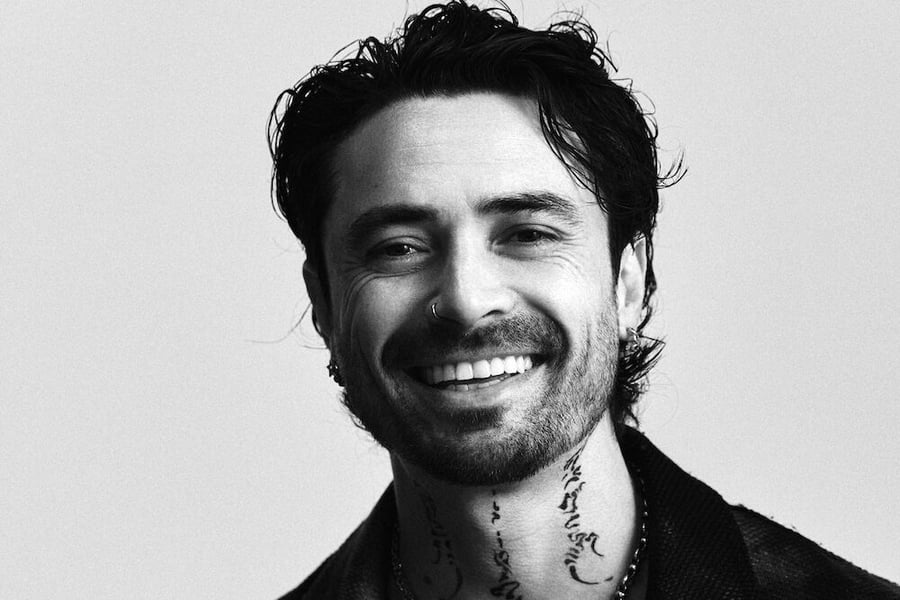
For a generation of Australians, Adam Saunders will always be Heath Carroll, the crushworthy, laid-back surfer on Blue Water High two decades ago. What they might not know, however, is that Saunders has spent much of his time since figuring out who he is when he isn’t playing a character – on screen or otherwise.
Over the years, he’s gone through almost every corner of the creative industries. After Blue Water High, there were more acting roles, including Home and Away and fellow teen-crush factory, Dance Academy. Then came a move behind the camera, where he built a career in production and creative direction.
Eventually, he founded his own agency and studio where he worked with artists and musicians. Now, though, as he nears 40, he’s reprioritising his own ambitions as a performer with his new musical project ADAM, and a recently released debut solo single, “Wait for Me.”
Music, as he tells me from his studio via Zoom, isn’t entirely new territory. In fact, long before we knew him as Heath, music was where his career and love for creativity began. “Music just has this way… I can’t really explain it. Some people talk about the great divine spirit, and I’m not a religious person, but I definitely feel something when I’m playing,” he says.
He recalls being put into performing arts at six after gatecrashing his sister’s classes, and by his teens, Saunders had been signed as one-third of boy band Jinx. It was his first taste of the music industry, although at that age, he says, he had little control over the kind of artist he was supposed to be.
“We were singers and dancers and just kind of going along with whatever the label was telling us to do, whatever songs they were giving us,” Saunders recalls. Acting soon intervened, before he – years later – reunited with former Jinx bandmate Dave Dennis and gave music another shot.
Love Music?
Get your daily dose of everything happening in Australian/New Zealand music and globally.

“That’s when I really started to learn guitar, learn how to write, learn how to produce,” he says. Those worlds collided on Dance Academy, where Saunders played pop star Myles Kelly, and managed to get some of his own music into the series, writing material for Keenan Lonsdale’s character, Ollie.
But it wasn’t until years later, during one of his regular solo camping trips, that Saunders was journalling and found himself writing down a simple question: What about music? “I was like, ‘Oh yeah, I’d totally forgotten about that,’” he laughs. “And I kind of looked around and was like, ‘Well, you’re here. Now’s the time.’” In saying that, he admits, the hardest part was convincing himself to actually do it.
“I had a lot of negative self-talk around myself, which was something new for me,” he says. “I’ve always been a very positive kind of person and I’m still very positive outwardly, but inwardly it got pretty dark for a while. So it’s been a lengthy process to get here, you know, just trying to build up the confidence to do it.”
That disconnect between the person Saunders presented to the world and what was happening underneath is something he’s spent years trying to unpack. Now, as he puts himself front and centre again, he tells me he is far less interested in maintaining an image than he is in being honest about the person behind it.
That means talking candidly about parts of himself he once felt compelled to hide – his sexuality, his relationship with masculinity, and the insecurities that sat beneath the confident teenager we all came to know and love on Blue Water High.
“I want to honour the 15-year-old self that was too scared to show up. I could be one way around one set of people and then have to be more macho around the other sort of people,” he says, recalling his days spent between performing arts and sports. “I was always so worried about being perceived, being seen as gay or queer, as a young boy dancing.”
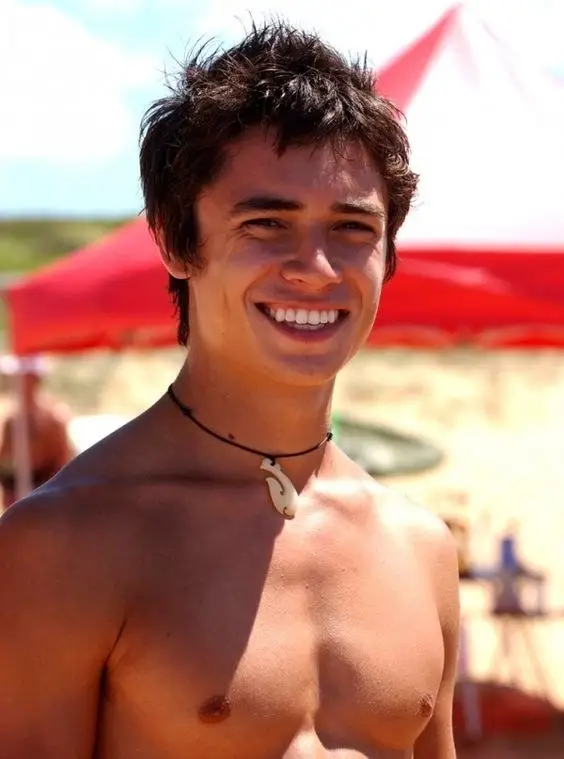
Adam Saunders as Heath Carroll in ‘Blue Water High’
That fear followed him into his early music, where Saunders says much of what he was doing was geared towards “chasing girls and partying” – an image he now recognises as being informed by ego and “misguided masculinity.” Underneath it, he says, was still a kid who didn’t always feel comfortable showing up as himself.
“If anything, I’m just trying to remember that sweet little kid and be like, ‘It’s okay to be him. It’s okay to be a little fruity. It’s okay to be a dork. You don’t have to be this cool kid,’” he says. “I hope to just move a little more authentically and honour that kid that kind of couldn’t show up when he wanted to.”
That desire to move more authentically is now at the heart of ADAM. Where Saunders’ first experience in the music industry involved being handed songs and told what to perform, this time around there is no character to slip into.
“I think now I’m just trying to be honest,” he smiles. “And I think that’s the only way any of this is going to cut through because nobody wants to see a 40-year-old guy trying to be a cool kid.”
Saunders is acutely aware that returning to music at this point in his life looks different to doing it at 15. He admits to hearing younger artists and occasionally questioning whether his own work sounds as “cool,” but he’s learning to resist the urge to measure himself against them.
“My stuff is just my story,” he says. “And I’m trying to just speak personally and hopefully it resonates universally because we’re all the fucking same at the end of the day. We’re all going through shit.”
His debut single, “Wait for Me,” tells his story beautifully. It was created during a difficult period in a relationship, when Saunders was trying to understand how best to support a partner experiencing serious mental health struggles.
Having long considered himself an optimist, his first instinct was to believe that mindset could fix almost anything. Over time, though, he began to better understand what his partner was experiencing and, more importantly, how he could actually support them.
But navigating it also left him with emotions of his own that he struggled to talk about. “It was really hard to talk about with anyone,” he admits. “It’s a pretty touchy situation.” So, instead, he wrote about it.
“It was kind of wild when the words came out. Again, it was this big relief.”
That sense of release is part of what keeps pulling Saunders back to songwriting. For all the different creative outlets he has explored over the years, he says music allows him to articulate feelings he might otherwise struggle to understand: “When I can put words to what I’m feeling, that definitely just feels like a great release. It’s cathartic.”
As for what’s next, Saunders is still working that out.
“There’s a bunch of songs that I’ve written over the past couple of years that I feel like I have to get out first,” he says.
Sonically, that could mean moving between the acoustic singer-songwriter side of Saunders and a more produced R&B sound – like “Wait for Me.” He’s not particularly interested in choosing between them, either, he adds. “If songs have two lives, that’s how they’re going to come out.”
An acoustic version of “Wait for Me”, recorded live at his recent launch event, is likely to be next. Saunders admits there are a few mistakes in the performance, but after spending so much of his younger life worrying about how he might be perceived, perfection isn’t really the point anymore.
“Fuck it,” he laughs. “It’s just going out raw. It is what it is.”
Maybe that’s the point of ADAM, I put to him. He’s not trying to distance himself from the characters so many of us grew up with, the teenage pop hopeful, or any of the other versions of himself that have existed along the way. Instead, he’s simply more comfortable letting them all exist, without worrying about which version people expect to see.
“Exactly,” he replies. “I just hope to move a little more authentically and honour every part of me.”
ADAM’s “Wait for Me” is out now.

